
Shared Hope International

Leading a worldwide effort to eradicate sexual slavery...one life at a time

  • The Problem
    • What is Sex Trafficking?
    • FAQs
    • Glossary of Terms
  • What We Do
    • Prevent
      • Training
      • Awareness
    • Restore
      • Programs
      • 3rd Party Service Providers
      • Stories of Hope
      • Partners
    • Bring Justice:Institute for Justice & Advocacy
      • Research
      • Report Cards
      • Training
      • Advocacy
  • Resources
    • All Resources
    • Internet Safety
    • Policy Research and Resources
    • Store
  • Take Action
    • Activism
    • Advocate
    • Just Like Me
    • Volunteer
    • Give
  • News&Events
    • Blog & Events
    • Media Center
    • Request a Speaker
    • Host an Event
    • Attend an Event
  • About
    • Our Mission and Values
    • Our Story
    • Financial Accountability
    • 2024 Annual Report
    • Leadership
    • Join Our Team
    • Contact Us
  • Conference
  • Donate
Home>Archives for Commentary

March 31, 2020 by Guest

Renting Lacy Reveals Reality: A Student’s Perspective

I was assignment to read ​Renting Lacy​ for a class on human trafficking at my university. Renting Lacy​ was a required book for the course. Though it was a quick read, it was notably substantive.

Renting Lacy is a fictional, yet reality-based story founded upon the biographies of the unfortunate lives that are involved in the child sex trafficking network in the United States.

The novel depicts a story of an underage girl and her co-workers who are trapped in a sex trafficking ring in Las Vegas. Lacy has been a victim of sex trafficking from a very young age and has been loyal to her trafficker, Bobby Bad, for many years now. She manages and cares for the other girls, Star, Sugar, Cherry, Brandi, and KiKi, who are stuck in her same situation. The book explains how Bobby grooms vulnerable girls by using love, affection, and gifts. Once they are hooked on him and the drugs he supplies, he detracts, leaving them wanting more. This is when he knows they will do anything for him, something even as dehumanizing as selling sex for money. Yet, they all feel a sense of loyalty and even fear towards him.

The mental torment, deceit, and violation the girls endure has left an immeasurable impact on me. Even more so, knowing that even though the book is a compilation of replicated accounts, these intertwining stories are consistent with the real life experiences of individuals manipulated into sex trafficking.

A unique aspect of ​Renting Lacy ​ is the comprehensive approach to defining, analyzing, and understanding the dynamics of a trafficking situation. Not only is the story told through the dialogue of traffickers and the targeted girls themselves, but of police officers, judges, family members, buyers, and sellers that are included as well. This is illuminating because there is so much value in the awareness of multiple perspectives in regards to the study of sex trafficking.

This book is raw, explicit and devastating, but it tells a strong story that is a solemn reminder of the vulnerabilities of our youth. It is a story that needed to be told to really grasp the interconnectedness and intersectional issues that are presented on this topic. The interwoven events of being trafficked and also being forced to engage in the victimization of others results in compounded trauma. For many of the girls in the book, the victim-offender intersections of their experiences makes the girls’ situation that much more complex. This leads them to be identified as criminal, rather than victim. Shared Hope released a report on this very issue in January that you can read here.

I am glad I got the opportunity to cross paths with ​Renting Lacy​ and take from it the knowledge and awareness of an issue that is happening all around us. It forced me to take a hard look at the world around me, instead of brushing off this topic as ‘someone else’s issue’. It is all of our problems and we are all part of the solution. This is an important book for future students to read, as well, because is motivates a discussion of the reality of sex trafficking. ​Renting Lacy is a humbling book that has the ability to spark initiative.
December 3, 2019 by Sarah Bendtsen

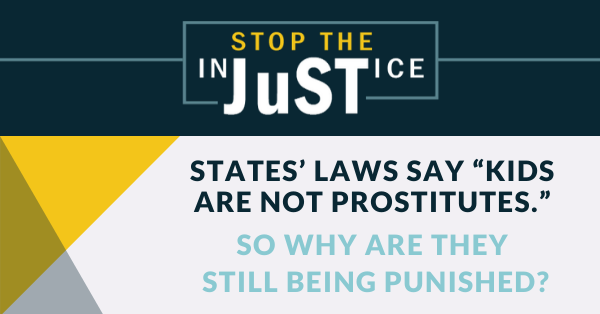
States’ Laws Say “Kids Are Not Prostitutes.” So Why Are They Still Being Punished?

States laws say "kids are not prostitutes" so why are they still being punished?

During the 2019 legislative session, nine states passed[1] critical legal reform measures to protect child sex trafficking victims from being prosecuted for prostitution, commonly referred to as “Safe Harbor” laws. However, as first pointed out in 2017, not all “Safe Harbor” laws actually insulate child sex trafficking victims from a punitive response for engaging in commercial sex. States, in an effort to carve out alternative processes for commercially sexually exploited minors, have developed a broad range of responses, ranging from the availability of an affirmative defense to full non-criminalization, with various other legal responses falling somewhere in between.  Once again, lawmakers underlined the prevailing conflict between the anti-trafficking community and other stakeholders that regard some commercially sexually exploited minors as consensual actors, needing of reform and punishment.

South Dakota is one such state that complicated the “Safe Harbor” narrative and furthered the disparate legal processes designed to address child sex trafficking victims.  Legislators this session passed House Bill 1063, which repealed the previous law that allowed 16 and 17 year old kids to be charged and prosecuted for prostitution. In demonstrating their support for the measure, several lawmakers emphasized the inherent injustice of prosecuting children for prostitution offenses, stating, “prostitute implies consent and that a minor chose,” “the key is getting them the help they need,” and “we need to get [the child victim] help, not treat them as a criminal.”[2]

So why are child victims in South Dakota, like many other states, still vulnerable to arrest and prosecution?

Undoubtedly, House Bill 1063 made an important legal and policy change; yet, in doing so, it amended the state’s Child in Need of Supervision (CHINS) process to include “a child who engages in prostitution by offering to engage in sexual activity for a fee or other compensation.”[3] The intent of the bill was to treat commercially sexually exploited minors as victims, not delinquents; however, as written, South Dakota’s new law will create very little practical change for child victims. Effectively, minors engaged in commercial sex will still be subject to an inherently adversarial process within the juvenile court system.

We strongly disagree. Unlike a protective response, deeming a minor survivor as a “child in need of supervision” denotes culpability and responsibility. Sending a youth survivor into the juvenile justice system, where the CHINS process is housed, commences a punitive process: a child is still taken into custody, charged with an offense, provided a sentence (albeit a “reformative” one), and placed on probation. Should the minor violate the terms of probation,[4] he or she is vulnerable to re-arrest and additional charges. No aspect of this process is trauma-informed or victim-centered.

Unfortunately, South Dakota is not the only state with such conflicted laws and practices. 11 other states have created alternative responses that fail to unequivocally identify and respond to all minors engaged in commercial sex as victims of sex trafficking.  Oftentimes, these alternative responses are utilized as a means of ensuring that the child is separated from the exploiter and engaged in services.  However, requiring youth survivors to participate in services or refrain from certain behaviors, as all diversion programs do, is a flawed response in the context of sex trafficking victimization. This design is not only incompatible with trauma, it is incompatible with justice.

First, placing requirements on exploited youth ignores the reality that survivors of sex trafficking commonly deny victimization and oftentimes must reach emotional, psychological, physiological, and spiritual stability before they can begin to safely and productively process and treat their exploitation. Secondly, mandatory participation in services fails to recognize that a key element of providing a protective response to survivors is refraining from repeating behaviors that mimic the behaviors of the exploiter, including conditioning protection on a survivor’s compliance with certain expectations or rules.  Lastly, requiring satisfactory participation in services negates the integral role that flexibility plays in responding to trafficking victimization. Healing is not linear; it is imperative that service responses allow for setbacks and pauses in order to ensure emotional safety and sustainable recovery. In addition to clashing with a requisite trauma-informed approach, diversion programs designed for commercially sexually exploited minors send mixed messages that survivors are somehow accountable for their own trafficking victimization.

While we acknowledge the legislative intent to protect and serve child survivors, we know there is a better and more developmentally appropriate and victim-centered way. Alongside survivors and ally practitioners in the field, we have been developing and advancing laws and policies that are designed to truly serve and safeguard the child, addressing the many layers of trauma and harm suffered, and equipping the survivor with tools for self-empowerment and freedom from both victimization and juvenile or criminal records.

We urge South Dakota, as well as the remaining 19 states that have limited or no protections, to develop and pass legislation that provides an empathetic, JuST response to youth survivors of sex trafficking.

For more information on protective responses for youth survivors and your state’s efforts to develop non-punitive avenues to services and care, please review the recently updated Stop the InJuSTice 2019 Toolkit and the 2019 Protected Innocence Challenge State Report Cards.


[1] The Texas legislature passed House Bill 1771 on May 27th which removed criminal liability for minors under 17 for prostitution offenses. Despite strong support from the anti-trafficking community, Governor Abbott vetoed the bill, stating his concern for “unintended consequences.”
[2] February 6, 2019 House Judiciary Committee hearing on House Bill 1063.
[3] S.D. Code Ann. § 26-8B-2.
[4] Research is increasingly demonstrating the cyclical effect of juvenile probation and the seemingly inevitable fate of violating its terms due to relentless scrutiny and stringent requirements that run can conflict with behaviors that are an inherent part of healthy adolescent development.

March 13, 2019 by Guest

Child Victims of Sex Trafficking Receive Mixed Messages: If We Aren’t ‘Aggressors’ Then Why are We Arrested?

In February, Kansas Judge Michael Gibbens came under fire in national news for claiming that two girls, ages 13 and 14, acted as “aggressors” in a situation of exploitation in which a 67-year-old male, Eugene Soden, paid them to have sex. While public reaction to Gibbens ruling was appropriately harsh, the reality is that his decision is reflective of a much larger societal and legal paradox.

Informing his ruling, Gibbens made multiple statements that less harm was done to the girls because he felt they had acted “voluntarily” and were paid. In speaking of the 13-year-old, Gibbens questioned:

“So, she’s uncomfortable for something that she voluntarily went to, voluntarily took her top off for, and was paid for?”

“I wonder, what kind of trauma there really was to this victim under those peculiar circumstances?”

As a society, we must ask, why did money sanitize what, in any other circumstance, would be considered child rape? And more concerning, how did the exchange of money shift the narrative so dramatically so as to characterize children as aggressors in the crime of which they were victims?

The answers lie in the paradox in which victims of child sex trafficking are legally apprehended and consequently, socially stigmatized.  Twenty-five states, including Kansas, still allow commercially sexually exploited minors to be charged and prosecuted for prostitution and human trafficking offenses despite federal and state laws that recognize these same minors as victims of child sex trafficking. This paradox still exists despite an increase in awareness, and specific laws to protect children from such offenses over the last couple of decades.

As recently as 2018, Shared Hope International scored Kansas an “A” for having strong laws to address child sex trafficking. Yet, even within a state that has received an “A” rating, more than 79 minor human trafficking victims between 2013 and 2018 were detained in a juvenile detention center, sentenced to an average of 33 days. Criminalizing youth who have experienced the horrors of commercial sexual exploitation, and oftentimes survived traumatic experiences that predate the exploitation, is not only the gravest of injustices but also prevents survivors from receiving critical services and ongoing, specialized care.

Laws, and the manner in which they are applied, should reflect a community’s attitudes and beliefs.

The law in Kansas fixes the age of consent at 16 in apparent recognition that sexual contact between an adult and a minor is not consensual. Despite this long-standing law and an increased understanding of the damaging effects of sexual violence, victim-blaming toward sex trafficking survivors remains. Gibbens’ comments towards the children in this case, reflect a culture that seeks to diminish or justify the harm of buyers and abusers by placing responsibility within the victims. The reactions of citizens, in which nearly half of the comments on social media placed blame on the minors and used terms such as “delinquent,” “out of control,” “promiscuous,” “prostitute,” and “choice” illuminate the reality of this disconnect. Illustrating this further, in response to Gibbens’ ruling, Kansas Attorney General Derek Schmidt proposed a new law that would prevent judges from reducing sentences for adult sex offenders because a child was labeled the “aggressor.” Kansas lawmakers rejected the bill.

Thus, amidst anti-trafficking awareness campaigns and fancy fundraisers, as Kansans we must ask ourselves: How do we really view individuals who have been victimized by and survived human trafficking? If we truly care, how do we shift our culture to recognize all survivors of sexual violence, including child sex trafficking, as unequivocally blameless in the conduct that constitutes their very victimization? How do we ensure that individuals victimized are afforded services, protection, and responses free of judgement and injustice, while simultaneously developing modes of accountability for offenders?

We must put an end to the paradigms, practices, and policies that allow survivors to be criminalized for surviving their victimization while perpetrators get a pass. Instead, we must believe the experiences of child victims of commercial sexual exploitation, and hold forth the truth of their innocence.  We must protect survivors and provide access to holistic services. We must demand justice.

For more information, please visit the Center for Combating Human Trafficking (CCHT) and Shared Hope International.

About the Authors:

Linda Smith served as state legislator and Member of Congress from Washington (1983-1998). She founded Shared Hope in 1998.

Dr. Karen Countryman-Roswurm is the Founding Executive Director of the Center for Combating Human Trafficking (CCHT) as well as an Associate Professor in the School of Social Work at Wichita State University. Grounded in her own life experiences of overcoming streets and systems, Dr. Roswurm has over two decades of personal, professional practice, and community-based research expertise in the Anti-Trafficking Movement.


April 24, 2017 by Susanna Bean

Shared Hope to Oppose California AB 1402

Tomorrow morning, Tuesday, April 25th the Public Safety committee of the California Assembly will hold a hearing on Assembly Bill 1402.  You can listen to the hearing here live, beginning at 8:30 AM PT.

California’s SB 1322 went into effect on January 1. This bill not only sparked a fiery discussion centered on one op-ed, it also led Assemblyman Travis Allen to introduce AB 1402 for purposes of repealing SB 1322.

Contrary to sensational statements that SB 1322 “legalized child prostitution,” the 2016 bill clarified that children engaged in commercial sex are victims of sex trafficking, deserving of a protective, not punitive, response.

Shared Hope is opposed to California AB 1402, and is working to protect the new law (SB 1322) ensuring that California children who have been exploited are treated as victims of a crime, not as criminals.

We have submitted opposition testimony for the hearing tomorrow.  The full text can be found here.

February 10, 2017 by Guest

I Am Jane Doe Film Premier

Opening in Theaters Friday, February 10th

I Am Jane Doe chronicles the epic battle that several American mothers are waging on behalf of their middle-school daughters, victims of sex-trafficking on Backpage.com, the adult classifieds section that for years was part of the Village Voice.  These mothers have stood up on behalf of thousands of other mothers, fighting back and refusing to take no for an answer. I Am Jane Doe is a gut-wrenching human story and fresh look at a social and legal issue that affects every community in America.

 As I Am Jane Doe opens this weekend our Senior Director, Nancy Winston shares her thoughts on the film.

Along with many others advocating to end the unimpeded internet advertising of sex for sale, I watched incredulously as the principals of Backpage.com and their lawyer all asserted protection under the first and fifth amendments before the Permanent Sub-Committee on Investigations last month.  We were then stymied by the Supreme Court refusal to hear the case of the Jane Does trying to hold Backpage.com liable for financial reparations for the suffering and devastation the victims endured.

Backpage.com and other internet sites that carry sex for sale ads, often of minors, impudently and confidently hide behind the immunity provided by the Communications Decency Act.  And clearly there is a closed door for any remedies through the court system.

The question that hangs heavy—where do we go from here?

But hope is dawning by way of the grassroots, often a more reliable generator of change.  On February 6 there was a screening in Washington DC of the new film by Mary Mazzio of 50 Eggs productions called I AM JANE DOE.  The film thoroughly recounts the nearly decade long efforts of the mothers of sex trafficked  “Jane Does” to bring attention to the terrible reality of their minor daughters’ experiences and to obtain reparations from the internet companies that boldly published ads for sex with their daughters.

The message of the film is very clear: Congress needs to address the problem through a modification to the CDA.  John Montgomery, legal expert in one of the JANE DOE cases describes the choice before Congress…”[they] could decide to protect the Internet or protect kids”.

Technology has outpaced the legal framework that was originally intended by that law.  Enacted in 1996, in the early days of the internet, it was intended to be a business saving framework that would protect the nascent tech industry from defamation suits for content posted by third parties.  But it was never intended to shelter criminal activity or to create a lawless internet.  Incredibly, this 20 year-old law now protects an on-line slave auction, a point so clearly brought home in I AM JANE DOE.

Clearly, any proposed change to the immunity Internet Content Service Providers enjoy under Section 230 of the CDA will be vigorously opposed by many, including all the tech giants, who will divert the argument to one of first amendment rights.  We will be facing off against a multibillion dollar industry, but it has become clear this is the only route.  I AM JANE DOE will be premiering in theaters around the country and then will soon be available via Netflix.  It gives a powerful voice to the grassroots advocacy that will bring the needed change to this law.

As one mom in the film said, “No matter how often you come against CDA, it’s always gonna shut you down”.  It’s time to end that shutdown.

—

Support this film and find a theater near you: www.iamjanedoefilm.com

  • < Previous Page
  • 1
  • …
  • 3
  • 4
  • 5
  • 6
  • 7
  • …
  • 15
  • Next Page >
  • What We Do
  • Newsletter Signup
  • Take Action
  • Donate
Shared Hope International
Charity Navigator Four-Star Rating

STORE | WEBINARS | REPORTCARDS | JuST CONFERENCE
 
Donate

1-866-437-5433
Facebook X Instagram YouTube Linkedin

Models Used to Protect Identities.

Copyright © 2026 Shared Hope International      |     P.O. Box 1907 Vancouver, WA 98668-1907     |     1-866-437-5433     |     Privacy Policy   |   Terms of Service

Manage your privacy
SHARED HOPE INTERNATIONAL DOES NOT SELL YOUR DATA. To provide the best experiences, we use technologies like cookies to store and/or access device information. Consenting to these technologies will allow us to process data such as browsing behavior or unique IDs on this site. Not consenting or withdrawing consent, may adversely affect certain features and functions.
Functional Always active
The technical storage or access is strictly necessary for the legitimate purpose of enabling the use of a specific service explicitly requested by the subscriber or user, or for the sole purpose of carrying out the transmission of a communication over an electronic communications network.
Preferences
The technical storage or access is necessary for the legitimate purpose of storing preferences that are not requested by the subscriber or user.
Statistics
The technical storage or access that is used exclusively for statistical purposes. The technical storage or access that is used exclusively for anonymous statistical purposes. Without a subpoena, voluntary compliance on the part of your Internet Service Provider, or additional records from a third party, information stored or retrieved for this purpose alone cannot usually be used to identify you.
Marketing
The technical storage or access is required to create user profiles to send advertising, or to track the user on a website or across several websites for similar marketing purposes.
  • Manage options
  • Manage services
  • Manage {vendor_count} vendors
  • Read more about these purposes
Manage options
  • {title}
  • {title}
  • {title}
Shared Hope InternationalLogo Header Menu
  • The Problem
    • What is Sex Trafficking?
    • FAQs
    • Glossary of Terms
  • What We Do
    • Prevent
      • Training
      • Awareness
    • Restore
      • Programs
      • 3rd Party Service Providers
      • Stories of Hope
      • Partners
    • Bring Justice:Institute for Justice & Advocacy
      • Research
      • Report Cards
      • Training
      • Advocacy
  • Resources
    • All Resources
    • Internet Safety
    • Policy Research and Resources
    • Store
  • Take Action
    • Activism
    • Advocate
    • Just Like Me
    • Volunteer
    • Give
  • News&Events
    • Blog & Events
    • Media Center
    • Request a Speaker
    • Host an Event
    • Attend an Event
  • About
    • Our Mission and Values
    • Our Story
    • Financial Accountability
    • 2024 Annual Report
    • Leadership
    • Join Our Team
    • Contact Us
  • Conference
  • Donate