Shared Hope International

Leading a worldwide effort to eradicate sexual slavery...one life at a time

  • The Problem
    • What is Sex Trafficking?
    • FAQs
    • Glossary of Terms
  • What We Do
    • Prevent
      • Training
      • Awareness
    • Restore
      • Programs
      • 3rd Party Service Providers
      • Stories of Hope
      • Partners
    • Bring Justice:Institute for Justice & Advocacy
      • Research
      • Report Cards
      • Training
      • Advocacy
  • Resources
    • All Resources
    • Internet Safety
    • Policy Research and Resources
    • Store
  • Take Action
    • Activism
    • Advocate
    • Just Like Me
    • Volunteer
    • Give
  • News&Events
    • Blog & Events
    • Media Center
    • Request a Speaker
    • Host an Event
    • Attend an Event
  • About
    • Our Mission and Values
    • Our Story
    • Financial Accountability
    • 2024 Annual Report
    • Leadership
    • Join Our Team
    • Contact Us
  • Conference
  • Donate
Home>Archives for Awareness

July 29, 2019 by Marissa Gunther

Running Upstream: A Call to Action this World Day Against Trafficking in Persons

RunningUpstreamBy Marissa Gunther, Director of Growth Strategies, Shared Hope International

Perhaps you’re familiar with the fable of the man and the river?

manandtheriver

The story is commonly told like this: A man sits peacefully on a grassy slope that rolls into a river’s edge, his family picnicking and playing nearby. As he listens to his children’s laughter, their shrieks of joy echoing off the hillside, a different more desperate sound breaks through.

A scream. Help!

Alarmed, the man frantically looks for the source and finds it coming from the river. A girl, no older than his own young daughter, is fighting for her life as the current sweeps her downstream.

Without thinking, the man takes off running down the slope into the icy waters and grabs the young girl before it’s too late.

Now, back at shore, the man wonders with wild confusion…How did this happen?

But before he can ask the frozen and exhausted child any questions, he hears another scream. Then another. And then another. The man looks back at the river to find dozens of children, girls and boys, hopelessly clambering to stay afloat as the river washes them away.

manontheriver2He quickly realizes that he can’t save all of the children alone. He needs more help.

He yells for other picnicking families from his village to join him in the rescue attempts – the village begins swimming as quickly as possible to rescue each child.

Soon rescue teams and fire trucks arrive, and out jumps the fire chief. She takes one long look at the situation and begins to run up the river, realizing that somehow, for some reason, the children keep falling in the river upstream. There is where she will find the source of the problem.

Like the fire chief, we too must hurry upstream and address the source.

Pictured, children at our Village of Hope, Pune India

For over 20 years, Shared Hope has been pulling children out of the deadly river that is child sex trafficking through restoration and empowerment. Currently, we’re providing funding and technical assistance to partners in India, Nepal, Jamaica and in the United States that provide safe housing, medical care, education, vocational training, and therapeutic services.

But someone – somewhere – is creating a demand for the children and vulnerable adults we’re helping. More and more children will fall into the river unless someone fixes the source.

We will not quit until every child is safe.
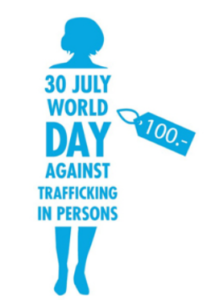
manandtheriver4And so, we support the United Nation’s global plan of action and will celebrate World Day Against Trafficking in Persons on July 30. We see this day not just as an occasion, but as an opportunity to educate the public about the scourge of human trafficking, to mobilize a political force and the resources needed to truly address the source of the problem, and to celebrate the achievements of the abolitionists of today and survivor leaders who bravely speak out and stand up to this evil. [easy-tweet tweet=”We support the United Nation’s global plan of action and will celebrate World Day Against Trafficking in Persons on July 30.” user=”SharedHope” hashtags=”SharedHope, StoptheInjustice” url=”https://www.un.org/en/events/humantrafficking/” template=”dark”]

Research spanning multiple decades, including data collected by both Shared Hope and the UN reinforce the fact that human trafficking is a global problem and no country is immune to it. Millions of victims fall in to the hands of traffickers, lured by fake promises and deceit, and fueled by the economics of market demand.

mandandtheriver5

Data also shows that trafficking happens all around us. According to the 2018 UN Global Report on Trafficking in Persons, the number of victims trafficked within their own country has doubled in recent years to a staggering 58% of all detected victims. Note that these numbers exclude the millions of suspected unreported cases.

In response, government entities around the globe have passed laws that aim to protect victims and hold offenders accountable. However, even with laws on the books, including laws passed at the state and federal level in the United States, victims continue to be trafficked and criminalized while the crimes of traffickers go unpunished.
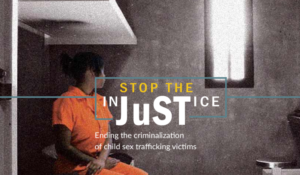
manandtheriver6Astonishingly, over one third of the states in the US lack laws that would prevent minor victims of sex trafficking from being criminalized for the crime of prostitution rather than ensuring they receive a protective response and specialized, trauma-informed services.

Yes, you read that right.

Child sex trafficking victims in the US are still being arrested for the crime committed against them.

So tomorrow, Shared Hope stands with the United Nations and celebrates their decision to focus 2019 World Day on highlighting the importance of government action in the interest of justice for victims.[easy-tweet tweet=”Shared Hope stands with the UN and celebrates their decision to focus 2019 World Day on highlighting the importance of government action in the interest of justice for victims.” user=”SharedHope” hashtags=”SharedHope, StoptheInjustice” url=”https://www.un.org/en/events/humantrafficking/” template=”dark”]

And, like the fabled man and his village, we are running full speed towards UN’s call to action – PREVENTION. Everyone, not just government entities, can take action to stop children from ever falling into the dangerous and brutal river that is sex trafficking.

manandtheriver7

We can, together, mobilize our own village of hope.

So you might be thinking…

Yes, yes, YES! Trafficking is a big problem and it will take a big village. So where is my place in all of this?

Shared Hope has a pathway to action for you. Right where you are, as you are.

Consider the following actions as a great place to start:

  1. Become well educated on the issue and learn as much as possible about what life is really like for trafficking victims. Take time to learn about the conditions that foster trafficking, and how this dark marketplace is fueled by buyers who pay traffickers to supply victims to meet their demand. Then educate others. As a place to start, we recommend reading or listening to the audiobook Renting Lacy by Linda Smith, which details eye-opening information based on real victim stories of youth bought and sold within the American commercial sex trade. Share the book with others when you’re done.
  2. Learn the warning signs and how to respond responsibly. To get you started, you can visit SharedHope.org to access several downloadable, free resources on warning signs and how to take action. You can report suspected child sex trafficking to the National Center for Missing and Exploited Children (NCMEC) at 1-800-THE-LOST (843-5678).
  3. Volunteer your time and talents. Shared Hope offers many on-ramps to taking action. Easier still, you can get started in any place that is comfortable to you, at your school, faith community, social media group – even in your own home. Our Ambassadors of Hope are trained and supported volunteers who carry the torch of prevention education into their communities, their voices causing a culture changing ripple effect across the nation. Join our team today!
  4. Your voice matters and can make a difference. Legislative advocacy is an effective tool that can strengthen legal protective responses to victims, ensure pathways to social services for survivors, and hold buyers and traffickers accountable. If you feel moved to learn more about the laws combating sex trafficking in your state, visit our legislative action center.
  5. Give a gift of hope. Your giving empowers Shared Hope to continue our work to eradicate child sex trafficking through prevention, restoration and bringing justice. You can make an impactful, tax-deductible donation to Shared Hope here.

We hope you’ll join us tomorrow, the 30th Day of July, as we run upstream, carrying forward our mission to end child sex trafficking.

We believe that together we can end human trafficking once and for all.
October 19, 2017 by Guest

The Smoke Screen That’s Obscuring the Voices of Survivors – Why We Must Amend the CDA

By: Alisa Bernard, Survivor Advocacy Coordinator, The Organization for Prostitution Survivors

I am of the technology generation. I was born the same year the cell phone was invented and Macintosh Apple made its debut. I never knew a time when a computer was not an accessible tool. We live in a time where computers the size of a credit cards can stream a giraffe giving birth across the country and can teach us how to do anything from play the violin to fix a leaky drain. The possibilities are limitless. But what happens when those possibilities are twisted into something darker? What happens when we use our innovations to trade in the flesh of young girls?

[easy-tweet tweet=”What happens when we use our innovations to trade in the flesh of young girls? – Alisa Bernard”  user=”SharedHope”]

The online sex trade is not new. When I was prostituted over a decade ago, I was sold online. Online prostitution is not glamorous and it is not safer than street prostitution. The violence endemic to prostitution is not somehow mitigated by the internet. One study stated that violence is perpetrated predominantly by buyers regardless of venue of solicitation. The internet has normalized the buying of sex down to a negligible transaction. Women and girls are being reduced to mail order masturbation aids.

[easy-tweet tweet=”Online prostitution is not glamorous and it is not safer than street prostitution. – Alisa Bernard” user=”SharedHope”]

[easy-tweet tweet=”The violence endemic to prostitution is not somehow mitigated by the internet. – Alisa Bernard” user=”SharedHope”]

The Senate’s proposed reforms to section 230 of the Communications Decency Act would allow for the prosecution of criminal activity on the part of internet service providers for facilitating the online sex trade. Essentially, businesses like Backpage.com could be held accountable for their contributions to the online sex trade. This is an essential step forward in the fight against trafficking in the US. Opposition activists express concern that the sex trade marketplace would make trafficking somehow more hidden or move underground if the online market is eliminated through this act. In reality, a result of the now internet facilitated sex trade is the intentional disappearing of both victims and traffickers. Backpage.com’s business model assists traffickers in obfuscating information in their ads, keeping them hidden behind bitcoins. Photos of children for sale across Backpage.com and similar sites have had their meta-data scrubbed away. Identification of victims and perpetrators has become practically impossible. How much more hidden could the market be?

According to the National Center for Missing and Exploited Children most cases of trafficking occur online and the majority of those are happening through Backpage.com. At first, I thought Backpage.com was simply ignoring the experiences of women and girls like me by populating their site with these ads. Backpage.com isn’t ignorant that we are being bought and sold on their website, they want us to be bought and sold on their website. Every ad costs a price and with hundreds of ads posted daily they won’t say no to such a profit margin. Never mind if most of the product is young girls and women so long as the profits keep rolling in. And why not if they can hide behind a bastardization of free speech laws.

The thousands of women and girls whose faces have glared across a Backpage.com moderator/editor’s screens are not products. Editing an ad for a child doesn’t change the facts. She’s 14 with a pimp, or 23 and her pimp’s name is poverty, editing doesn’t make that 14-year-old 18, and it doesn’t change the 23-year-old’s circumstances. It does, however, add another few dollars into the Backpage.com bank account. So yeah, I care that there are more stringent requirements to post a car for sale than there are to post a young girls body.

Do the rapes of innocent women and girls mean so little? Have we accidently put the freedom to facilitate the rape of girls above girl’s freedom to be safe from rape? Reform is needed. The changes proposed to the CDA do not allow for the mass hysteria the tech industry would have you believe. The changes in the language do not allow for overzealous trial attorneys to go suing innocent internet service providers. If they are doing nothing wrong, they have nothing to fear. If they are using the CDA as a cover to hide their own perpetuation of the sex trade then, yes… they should have much to fear.

[easy-tweet tweet=”If (tech companies) are doing nothing wrong, they have nothing to fear (from amending the CDA). ” user=”SharedHope”]

I am firmly for the protection of the First Amendment and believe that it is one of the most integral core tenets of any free society. However, using the CDA as a smoke screen to conceal trafficking is just as much an attack on free speech as stripping the First Amendment bare. The modern era is rife with technological advancement, and we must update our laws to reflect this ever changing landscape.

I stand in solidarity with those who work to reform section 230 of the CDA, and I beg you, from someone who has seen what the online sex trade really looks like, to mobilize around this issue. Get your voice out, get your opinion out, because our voices cannot be the only ones to stand up.

[easy-tweet tweet=”Get your voice out, get your opinion out, because our voices cannot be the only ones to stand up.”]

June 16, 2017 by Jo Lembo

Inspired to Give Back – Ambassador Spotlight

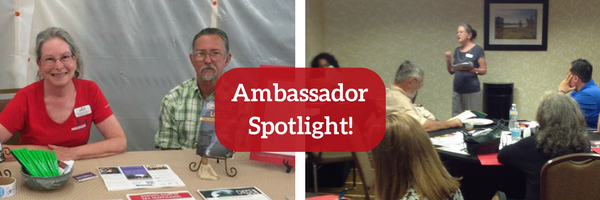
Karen Lambie felt driven to do something to “give back” to society after retiring from teaching. Her online research into children’s rights issues brought her across the sex trafficking of children. Like so many of the people in our audiences, she was shocked to discover its rampancy in the United States and in her own home state of Georgia. She knew she had to help stop this heinous crime, and her continued search led her to Shared Hope International. Joining the Ambassador of Hope Program, Karen found her calling.

She took her Ambassador role very seriously, especially after learning that the foster children she and her husband, Tom, had in their home were from the highest risk demographic. She wasted no time talking to the director of her Department of Family and Children’s Services which led to an introduction to the Adoptive and Foster Parents Association of Georgia (AFPAG) which rippled into speaking opportunities all over the state of Georgia, including three state conferences.

Karen’s husband, Tom, became an Ambassador because he wanted join her in educating the public and to do whatever he could to help prevent children from becoming victims. Sharing with their family and friends about what they are doing continually resulted in more invitations to host booths at a variety of events.

Karen’s main tactic is to make sure people have her business card and that they know there is no speaker fee. Karen shares hope by not only presenting the signs of trafficking, but by assuring people walk away with excellent tools to prevent trafficking.

Karen’s list of presentations is diverse, from university classes to speaking at a family reunion, and she even hosted a resource table at a “Responsible Dog Ownership” event!

Something fun that she likes to include in her presentation? “One activity that can lighten the mood after the heaviness of introducing the topic is to role play how traffickers may approach a child, young person, or even an adult in public by claiming they are a modeling or acting agent. Asking for a volunteer (male or female) from the audience, I ask them to pretend they are a 13-year-old and shopping in a mall.”

“Approaching the individual and gushing about how beautiful or handsome they are usually gets some laughter. I promise them I can get them into magazines and movies. Then I ask them to come with me to the parking lot where my camera equipment is or hand them a business card and tell them to give me a call. Even though their reactions are often very humorous, the very serious point is made.”

Karen keeps her goals simple: To stay tuned in listening for people that might be interested in having a speaker or where she can host a booth. “For as long as I am able, I will raise my voice against the scourge of child sex trafficking.”

[easy-tweet tweet=”“For as long as I am able, I will raise my voice against the scourge of child sex trafficking.” ” user=”SharedHope”]

 Your voice counts, Karen, more than you’ll ever know because we can’t count how many kids are safer because you shared the signs of trafficking.  Thank you for all you do!

We need more Ambassadors to educate their communities on preventing sex trafficking.  Apply today!

May 30, 2017 by Guest

The Ripple Effect

Chifonne, one of our Ambassadors of Hope shares her story! 

When I first heard about sex trafficking, I was probably 12 years old. It was the very early days of Shared Hope, not long after Linda Smith had been to India, and she shared at a local event where my mom heard what Linda saw and experienced, and how she was working to help. My mom was incredibly moved by what she learned, and in turn, told a number of other people about it. I was, of course, one of those people. I was shocked and horrified that girls could be SOLD as if they were property.

Chifonne & Lindsay

I remember going to my best friend Lindsay’s house and telling her about it. She was also outraged, and we decided we had to do something to help these girls. We convinced our children’s pastor to let us make a presentation to our children’s church, as long as we promised not to use words like “sex”. I remember the two of us standing in front of all our friends that Sunday morning and telling them about kids our age or younger who were slaves, and how we could help free them. We took an offering that morning and raised $34, which we sent to Shared Hope.

This happened 17 years ago, but it was the start of something significant for both Lindsay and me.  I’ve been an Ambassador for several years, and have also been part of other local teams and groups working to end Domestic Minor Sex Trafficking. My friend Lindsay went on to co-produce a documentary about sex trafficking in the US, Sex + Money: A National Search For Human Worth to which Linda Smith was a contributor, and which screened at college campuses across the nation. Both Lindsay and I have continued at times doing work abroad with girls and children at-risk.

[easy-tweet tweet=”You never know how people’s hearts are being stirred by your words.” user=”SharedHope”]

I say all of this not to toot our proverbial horns in any way, but as a reminder for all of us who work to raise awareness. You never know how people’s hearts are being stirred by your words, or what they may do in response to being informed. If you recall, neither my friend nor I had been at an actual “presentation.” Someone who had been – my mom – shared with me, and I shared with a friend, who in turn shared with a lot more friends. That ripple effect is happening ALL THE TIME. What you do has impact that reaches far wider than you may realize.

[easy-tweet tweet=”What you do has impact that reaches far wider than you may realize. ” user=”SharedHope”]

Chifonne, Washington State Ambassador

We need your help to take action and offer prevention education in your community! Become an Ambassador of Hope today! 

[easy-tweet tweet=”Shared Hope needs your help, become an Ambassador of Hope today! ” user=”SharedHope”]

May 26, 2017 by Savanah Lawrence

Battling Sex Trafficking in South America: From Panic Mode to Planning Mode

“We have to shift from panicking mode to planning mode.” These wise words, by the Ambassador, Permanent Observer of Italy to the OAS, Marilina Armellin, were spoken at a trafficking event hosted by the Organization of American States (OAS) which Shared Hope attended this week. During the event we learned that most countries in South America are facing the panic of sex trafficking and struggling to find solutions to its many challenges. But many efforts are underway to help the region move from panicking to planning, and from planning to implementation. And at least one country is beginning such implementation

Panicking Over the Challenges

Marcella was born in Columbia. As a young, single mother, she was the perfect target for traffickers. She worked two jobs to care for her young child. But when the baby became sick, she lost her jobs and out of panicky desperation contacted a recruiter who offered to take her to Japan to dance and make a comfortable living. But the offer was a trap. When she arrived in Japan, her passport and money were taken and she was told she was the property of the Japanese mafia and must pay back her debt by prostituting herself.  She suffered for 18 months, forced into prostitution and its associated abuse, before she was able to escape. Yet sadly, upon her return to her home country, law enforcement did not believe her. She was repeatedly questioned and asked whether she was truly trafficked or simply chose to prostitute herself. After receiving no help or support, still reeling from the effects of her trafficking experience, Marcela turned back to prostitution.

Sadly, Marcela’s story is not unique. With little education and no opportunity, coupled against the prevalence of sexual discrimination, women and girls are the most vulnerable demographic in South America. Moreover, most of the countries’ infrastructures cannot handle the volume of trafficking cases. The problem of sex trafficking is further exacerbated as these countries struggle to collect data, identify victims, and provide services for trafficked victims. In sheer panic over the issue of sex trafficking, these countries focus on punitive laws rather than victim-centered policies, and like Marcela’s case, many cases are ignored, and trafficked victims return to their exploitation.

Moving from Panic to Planning and Implementation

While panic fills the region, one country is beginning to plan and implement policies to overcome the battle against sex trafficking. Argentina has moved from panic mode to planning mode. Argentina has begun incorporating three key policies and is seeing positive results. These policies are:


  1. Identification of sexual exploitation and victims
  2. State-provided legal representation
  3. Preventing victims from being considered criminals.

Argentina has used an abolitionist system since 1930, incorporating rescue programs with police raids to help identify and separate victims from perpetrators. This allows victims to recognize their own status as a victim. Furthermore, Argentina has begun providing legal representation for victims. This educates victims on their rights and the trafficking legal framework, and gives victims a chance to heal. Finally, in 2009 Argentina began incorporating an orientation for the prosecutor’s office, briefing prosecutors on the trafficking legal frame work and the severity of the crime. They also implemented a law prohibiting victims from being punished for crimes they may have committed as a result of their exploitation. In total, Argentina’s success is coming as they increase their efforts to identify victims and then protect those victims from further exploitation. By creating this victim-centered focus, Argentina is seeing positive results and moving away from panic mode into planning and implementation mode.

Other Issues Still Needing Solutions

While Argentina is making great headway by implementing victim-centered policies, the region as a whole still faces many other issues seeking solutions. Two of these issues are: 1) the transnational nature of sex trafficking, and 2) reducing conditions that favor migration.

Too often victims are trafficked out of their own country, through many others, and eventually end at their final trafficking destination. The countries of South America need to find a way to protect victims beyond the borders of their state, providing protection in the origin country, the transit countries, and finally in the destination country.

Sex trafficking also often occurs as people attempt to migrate. In order to combat trafficking, advocates contend that we need to reduce migration, which occurs because of lack of opportunity in a person’s place of origin, and an overvaluation in the place of destination. As people migrate, they lose their support system; become unfamiliar with their surroundings, the culture, and even the language; and they become vulnerable.

Sex trafficking is a terrifying reality, and there is much work to be done in the region. But thankfully through organizations like the Organization of American States, countries and anti-trafficking groups can begin to move from panic mode to planning mode, and begin to eradicate sex trafficking.

  • < Previous Page
  • 1
  • …
  • 3
  • 4
  • 5
  • 6
  • 7
  • …
  • 36
  • Next Page >
  • What We Do
  • Newsletter Signup
  • Take Action
  • Donate
Shared Hope International
Charity Navigator Four-Star Rating

STORE | WEBINARS | REPORTCARDS | JuST CONFERENCE
 
Donate

1-866-437-5433
Facebook X Instagram YouTube Linkedin

Models Used to Protect Identities.

Copyright © 2026 Shared Hope International      |     P.O. Box 1907 Vancouver, WA 98668-1907     |     1-866-437-5433     |     Privacy Policy   |   Terms of Service

Manage your privacy
SHARED HOPE INTERNATIONAL DOES NOT SELL YOUR DATA. To provide the best experiences, we use technologies like cookies to store and/or access device information. Consenting to these technologies will allow us to process data such as browsing behavior or unique IDs on this site. Not consenting or withdrawing consent, may adversely affect certain features and functions.
Functional Always active
The technical storage or access is strictly necessary for the legitimate purpose of enabling the use of a specific service explicitly requested by the subscriber or user, or for the sole purpose of carrying out the transmission of a communication over an electronic communications network.
Preferences
The technical storage or access is necessary for the legitimate purpose of storing preferences that are not requested by the subscriber or user.
Statistics
The technical storage or access that is used exclusively for statistical purposes. The technical storage or access that is used exclusively for anonymous statistical purposes. Without a subpoena, voluntary compliance on the part of your Internet Service Provider, or additional records from a third party, information stored or retrieved for this purpose alone cannot usually be used to identify you.
Marketing
The technical storage or access is required to create user profiles to send advertising, or to track the user on a website or across several websites for similar marketing purposes.
  • Manage options
  • Manage services
  • Manage {vendor_count} vendors
  • Read more about these purposes
Manage options
  • {title}
  • {title}
  • {title}
Shared Hope InternationalLogo Header Menu
  • The Problem
    • What is Sex Trafficking?
    • FAQs
    • Glossary of Terms
  • What We Do
    • Prevent
      • Training
      • Awareness
    • Restore
      • Programs
      • 3rd Party Service Providers
      • Stories of Hope
      • Partners
    • Bring Justice:Institute for Justice & Advocacy
      • Research
      • Report Cards
      • Training
      • Advocacy
  • Resources
    • All Resources
    • Internet Safety
    • Policy Research and Resources
    • Store
  • Take Action
    • Activism
    • Advocate
    • Just Like Me
    • Volunteer
    • Give
  • News&Events
    • Blog & Events
    • Media Center
    • Request a Speaker
    • Host an Event
    • Attend an Event
  • About
    • Our Mission and Values
    • Our Story
    • Financial Accountability
    • 2024 Annual Report
    • Leadership
    • Join Our Team
    • Contact Us
  • Conference
  • Donate