Shared Hope International

Leading a worldwide effort to eradicate sexual slavery...one life at a time

  • The Problem
    • What is Sex Trafficking?
    • FAQs
    • Glossary of Terms
  • What We Do
    • Prevent
      • Training
      • Awareness
    • Restore
      • Programs
      • 3rd Party Service Providers
      • Stories of Hope
      • Partners
    • Bring Justice:Institute for Justice & Advocacy
      • Research
      • Report Cards
      • Training
      • Advocacy
  • Resources
    • All Resources
    • Internet Safety
    • Policy Research and Resources
    • Store
  • Take Action
    • Activism
    • Advocate
    • Just Like Me
    • Volunteer
    • Give
  • News&Events
    • Blog & Events
    • Media Center
    • Request a Speaker
    • Host an Event
    • Attend an Event
  • About
    • Our Mission and Values
    • Our Story
    • Financial Accountability
    • 2024 Annual Report
    • Leadership
    • Join Our Team
    • Contact Us
  • Conference
  • Donate
Home>Archives for Policy>Safe Harbor

September 20, 2022 by Guest

“My story can change things.” – Pieper Lewis, September 13, 2022

In sentencing child sex trafficking survivor, Pieper Lewis, on September 13, 2022, Judge David Porter stated, “Ms. Lewis, this is the second chance you asked for. You don’t get a third. Do you understand?”

The judge was alluding to his sentencing order that imposed a term of probation in lieu of immediate imprisonment, however the “second chance” he believed he was providing is nevertheless one rooted in punitive responses for trafficking survivors. If the anti-trafficking movement is committed to moving toward truly trauma-informed approaches, “second chances” must not include criminalizing survivors for trauma and offenses committed as a result of trafficking victimization; “second chances” must not include tools of control and punishment that resemble a survivor’s past exploitation, including incessant supervision, adherence to strict rules, placement in locked facilities, and debts to earn freedom.

Yet, in providing a “second chance” to Pieper, Judge Porter ordered Pieper to pay her exploiter’s family $150,000 in restitution,[1] the court an additional $4,000 for expenses incurred in her prosecution,[2] and, for the next five years, to wear an ankle monitor, remain on probation, and live in a facility managed by the Iowa Department of Corrections. Further, if Pieper violates any term of her probation, the court is authorized to reimpose a 20-year term of imprisonment.

Trafficking another person, raping them, exposing them to abuse after abuse is horrendous. While a person being trafficked is still breathing, and therefore technically alive, their life is no longer their own. Victims of human trafficking are subjected to a level of control that enslaves them fully, mind and body. They are subjected to abuses, assaults, and a commodification that reduces them to a product and shreds the soul.

Prosecutors argued that Brooks was asleep at the time he was stabbed and therefore not an immediate danger to Lewis. Such assertions can only be made by someone entirely disconnected from the intensity of trauma and human trafficking. Brooks had drugged and raped Pieper repeatedly, on more than one occasion, contributing to a pattern of sexual violence inflicted on her, as well as other harm, including homelessness and poverty.

Pieper Lewis, a 15-year-old child at the time of her arrest, has not been treated as such, nor has she been treated as the victim she was and, as she rightfully claimed in court, the survivor she is.  Indeed, Pieper powerfully demonstrated her resilience during her sentencing hearing, “Today, my voice will be heard. The story of Pieper Lewis holds power. The trauma of Pieper Lewis carries a ruptured beginning, tormented past and a delayed future. With perseverance, we have the ability to change the direction of our delayed and unknown futures.” But she also spoke to how the criminal justice system had overlooked and ignored her victimization as she was prosecuted for a crime that directly arose from the abuse and trauma she experienced through trafficking, “I wish the events that took place on June 1, 2020 never occurred, but to say there’s only one victim to this story is absurd.”

Even when imprisonment is avoided, criminal and juvenile justice responses are inherently punitive and often compound trauma, contribute to cycles of poverty and exploitation, and fail to positively contribute to the survivors’ healing. They also cement cultural beliefs and practices that blame victims for their own harm suffered. This is the reason more comprehensive approaches to preventing survivors from being criminalized are at the core of survivor-centered reforms.

As a judge in a state that continues to allow children to be charged with prostitution–conduct that is synonymous with their trafficking victimization–Judge Porter’s ruling cemented the victim-blaming beliefs that have undermined efforts to protect rather than punish child sex trafficking victims in Iowa.

Iowa currently joins 23 states that still criminalize children for prostitution, 34 states that still allow children to be charged and prosecuted for other non-violent crimes or trafficking charges that resulted from their trafficking victimization, and 42 states that still do not allow child sex trafficking victims, like Pieper Lewis, to assert a defense to violent felony charges that arose from trafficking victimization. We as a country have a long way to go to recognize, in our laws and within our judicial system, the harm that is caused by continuing to treat victims of trafficking as criminals while ignoring the impact of their victimization.

Together, The Genesis Project, Shared Hope International, and the Iowa Network Against Human Trafficking and Slavery seek just responses for trafficking survivors, including Pieper. We strongly urge dramatic change in how survivors of trafficking are treated in Iowa and beyond. We invite you to join us and help shift the status quo to one that protects survivors rather than blaming and punishing them for their own victimization.

Footnotes:

[1] https://www.gofundme.com/f/vxgt7q

[2]  The prosecution of Pieper Lewis was inherently unjust as the lack of legal protections (e.g., an affirmative defense, non-criminalization protection) available to human trafficking victims under Iowa state law and, thus, unavailable to Pieper, left her with no legal remedies. As a result, despite her status as a child sex trafficking victim, she was arrested, prosecuted, and sentenced for an offense that arose from her trafficking victimization. In response to the injustice of Pieper being prosecuted and sentenced in the death of her abuser, without access to legal protections, advocates and supporters of Pieper have raised over $550,000 (as of September 19, 2022) to pay her restitution order and court fees and provide additional funds to positively impact Pieper’s trajectory. To learn more about best practice for responding to sex trafficking victims engaged in criminal or delinquent conduct, please visit: https://reportcards.sharedhope.org/safeharbor/.
June 15, 2022 by Sidney McCoy

Legislative Update Series: State Non-criminalization Laws

Shared Hope has been a leader on policy research in the field of child and youth sex trafficking for over 20 years, working to ensure federal, state, and local policies are rooted in and supported by research and promising practices. Shared Hope’s Policy Team provides technical assistance and advocacy support to Congressional and state legislators seeking research-based, survivor-centered, and field-informed policy solutions to address child and youth sex trafficking. As Congress heads into Summer Recess and 27 of the 46 states in session in 2022 have adjourned for the calendar year, Shared Hope is doing a legislative update blog series on state and federal laws that have been introduced and enacted with the potential to impact survivors of child and youth sex trafficking. [Read more…]

June 14, 2022 by Sidney McCoy

Fact Sheet: Protecting Trafficking Survivors from Unjust Criminalization

Updated 2/21/2025

It is commonly known that unjust criminalization can be retraumatizing and creates an uneasy relationship between the survivor and the legal justice system. However, many state and federal laws continue to charge victims of human trafficking with the crimes they committed under coercive force by their traffickers. These crimes are frequently prostitution offenses but may also include misdemeanors and felonies ranging from theft to more serious violations.  The victim often commits these crimes to appease their trafficker or survive their situation. These “victim–offenders,” or survivors who find themselves in the intersection of victimization and criminal offender, are retraumatized by their detention and prosecution.  They are also left with a criminal record that hinders their enrollment in higher education, limits their ability to purchase a home, and restricts their access to work opportunities.  The inability to develop their lives may leave survivors feeling stuck, financially restricted, and with no way to excel except by returning to their trafficker. Although some states have taken action to address this by allowing trafficking victims to vacate unjust convictions, Congress has yet to take similar action on this issue.

To address this issue and provide enduring support for trafficking victims, Shared Hope International supports introducing the Trafficking Survivors Relief Act (TSRA). The TSRA seeks to amend Title 18 of the U.S. Criminal Code. The amendment permits vacatur, or complete removal from an individual’s record, for non-violent criminal offenses when the offense was directly related to having been a victim of trafficking. See C(I). TSRA also provides victims with confidentiality by filing any document relating to the motion to vacate under seal and withholding any identifying information from public inspection.

Finally, the TSRA further amends Title 18 by adding a human trafficking defense. This defense establishes a rebuttable presumption that the offense was induced by duress, force, or coercion, wherever any defendant establishes by clear and convincing evidence, that they were a victim of trafficking at the time of the committed offense.

The Trafficking Survivors Relief Act accomplishes these goals by:  

  • Amending Title 18 to allow a rebuttable presumption that certain offenses committed by victims of human trafficking were induced by coercion.
  • Amending Title 18 to permit a motion to vacate or expunge criminal offenses based on the mitigating factor that the alleged conduct that resulted in the arrest was directly related to the movant having been a victim of trafficking.
  • Sealing any identifying record or part of the proceeding related to such motion from the public record.

Current Sponsors:

House: Russell Fry, Ted Lieu, Ann Wagner, Robert Garcia, Hank Johnson, Debbie Dingell, Ami Bera, Andy Biggs, Greg Landsman, Michael Lawler, Emilia Strong Sykes, Byron Donalds

Learn More & Cosponsor:

  • Visit https://sharedhope.org/what-we-do/bring-justice/ to access Shared Hope’s research and advocacy resources.
  • TSRA Myths vs Facts
  • TSRA Fact Sheet
  • For technical assistance, contact our Policy team at Policy@sharedhope.org

Additional Sources:

  • Trauma, Coercion, And the Tools of Trafficking Exploitation: Examining The Consequences for Children And Youth In The Justice System, 109 Ky. LJ. 719. https://sharedhope.org/wp-content/uploads/2021/12/TRAUMA-COERCION-AND-THE-TOOLS-OF-TRAFFICKING-EXPLOITATION-EXAMINING-THE-CONSEQUENCES-FOR-CHILDREN-AN.pdf .
  • Responding to Sex Trafficking Victim – Offender Intersectionality: A Guide for Criminal Justice Stakeholders, https://sharedhope.org/wp-content/uploads/2020/01/SH_Responding-to-Sex-Trafficking-Victim-Offender-Intersectionality2020_FINAL.pdf.

September 29, 2021 by Sarah Bendtsen

Wisconsin Senate Bill 245 Testimony

Shared Hope International has been working in Wisconsin, across the country, and internationally for over 20 years to guide and support appropriate responses to protect survivors, hold offenders to account, and ultimately prevent the crime entirely. 11 years ago we launched the Protected Innocence Challenge project (i.e. State Report Cards) to assess the status of state’s laws and to drive legislative progress. Since 2011, we have called on states to recognize any minor engaged in commercial sex as a victim of a sex trafficking, not a “prostitute” or “delinquent youth.” We know that survivors of child sex trafficking have the best outcomes when they are met with protection, trauma-informed services, and a response that is appropriate for the horrific experiences they have endured—such a response cannot be rooted in juvenile justice practices and systems.

Amending the prostitution statute to be inapplicable to minors recognizes that children never engage in commercial sex by choice; rather, a child does so out of coercion, force, fraud, fear, or survival. This is not consensual sex; money does not sanitize rape and treating the child as consensual actor not only misplaces criminality, it directly re-victimizes the child. Oftentimes, children entangled in a life that includes commercial sex carry years of trauma, generational vulnerabilities, and abuse on their backs. Other times, such children have trusted the wrong adult, been fed a false promise, or have fallen for an exploiter who later sold the child to someone all too willing to pay for the chance to rape him or her. Children with unsafe or unstable home environments may find the streets safer and, resultantly, sell their bodies in exchange for something to eat or someplace to sleep. These are not choices; children living in such circumstances deserve, at a minimum, specialized services and long-term care, not the traumatizing impact of an arrest, detention and prosecution, or juvenile records that carrying devastating collateral consequences far beyond childhood years.

In 2014, four years after releasing the first State Report Cards, we graded Wisconsin a “B” state for having a set of strong, comprehensive laws that address child sex trafficking; for the last 8 years, Wisconsin has consistently scored higher than the national average in developing robust policies and practices related to child sex trafficking. However, despite holding a position of leadership, the state has lagged seriously behind a majority of the country in designing and prioritizing protective responses for survivors. 31 states and D.C. have made clear that children engaged in commercial sex are victims of sex trafficking, no prostitution offenders. While Wisconsin state law clearly defines children who are bought and sold for sex as victims of sex trafficking, those same minors can be and are arrested and prosecuted for prostitution. SB 245 is not only critical for remedying this legal paradox; this legislation embraces a nationally-regarded promising practice for protecting children and preventing harm.

Concerns have previously been raised that, without the ability to arrest child sex trafficking victims, law enforcement are limited in their ability to keep vulnerable youth safe. We wholeheartedly share the desire to ensure survivor safety; however, arrest is not the only and certainly not the appropriate mechanism for doing so. Alternatively, many states that have enacted and successfully implemented Safe Harbor responses have abandoned the use of arrest and adopted more child-friendly and appropriate tools for taking children into custody, including the use of temporary protective custody provisions. Fortunately, Wisconsin has already developed this mechanism under Wis. Stat. § 48.19(d).

SB 245 not only aligns with promising and child-centered responses to sex trafficking but amplifies survivors’ calls for justice. Our decades of research and collaborative work with trafficking survivors has illuminated the harms of punitive responses to victims; survivors continue to reiterate the additional trauma and harm that is caused during arrest, detention, and prosecution, even if such responses are well-intended and designed break the cycle of exploitation, including

Wisconsin’s current diversion response to child sex trafficking victims. Conversely, responses outside of punitive systems are proven to be more effective, cost-efficient, and impactful in addressing survivors comprehensive needs and goals, and preventing the predictable cycle of vulnerabilities, exploitation, criminalization, and increased vulnerabilities to reexploitation.

We commend the Sponsor’s leadership on this issue and are grateful for the Committee’s interest in supporting an alternative, more survivor-centered and justice-oriented response.


If you live in Wisconsin, urge your legislators to support Senate Bill 245 and end the criminalization of children with prostitution.

August 26, 2021 by Camryn Peterson

Advanced Legislative Framework: Issue Areas #2 & #3 – Expanding Victim Protections and Care

Advanced Legislative Framework: Issue Area #2 (Identification and Response to Victims) and Issue Area #3 (Continuum of Care)

This fall, we will release state Report Cards based on our Advanced Legislative Framework, pushing states towards a victim-centered response to child and youth sex trafficking.

The framework is based on six issue areas that review state’s policies in addressing this injustice. Last month, we reviewed issue area one—Criminal Provisions.

This month, we want to highlight two issue areas aimed at supporting victims of child sex trafficking and ending the cycle of exploitation—Identification of and Response to Victims and Continuum of Care.

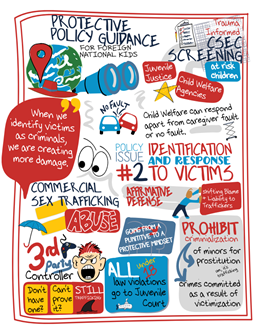
Issue area #2 focuses on the importance of proper identification and response to victims of child and youth sex trafficking. All too often, child sex trafficking victims are misidentified as offenders and are directed into systems where their exploitation and trauma is overlooked. It is vital that all commercially sexually exploited children and youth are recognized as victims of trafficking and receive a protective, not punitive response from child serving systems and law enforcement so they receive appropriate care. This is true even if a third party controller wasn’t involved.

What is a third party controller? A third party controller is someone who is managing the exchange of sex with the child and the buyer, otherwise known as the trafficker. In some cases of sex trafficking, there isn’t a third party controller, but a buyer directly exploiting a child who is in need of money, a safe place to stay, or is exploiting other vulnerabilities of the victim. That buyer scenario is still considered child sex trafficking.

Not only are victims misidentified, but many are treated as perpetrators of crimes. Victims of child sex trafficking may commit offenses in response to their own status as a victim, which should be acknowledged when they interact with law enforcement and welfare agencies. This includes ending the criminalization of children and youth for prostitution. Under federal law, any child involved with commercial sex is a victim of sex trafficking, but some states still penalize minors for this crime. When their status as a victim is ignored, they are further traumatized by the punishments they receive, prolonging their healing process and denying access to vital services and legal defenses.

To further help prevent or accurately identify sex trafficking, issue area #2 calls for increased trauma-informed screening of vulnerable children and youth in the child welfare and juvenile justice systems. With increased screening, policies must also be put in place to ensure that these systems are able to respond with appropriate services.

With proper identification and movement away from punitive responses to victimization, we lean into our third issue area.

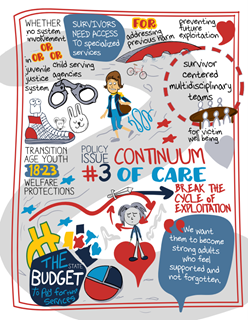
Issue area #3, Continuum of Care, addresses the need of more services for victims of child and youth sex trafficking and vulnerable populations.


It is essential that the specialized services victims receive are through non-punitive means to avoid further traumatization or re-exploitation. This can be achieved through a coordinated effort amongst law enforcement, service providers, and other advocates by establishing state-wide multi-disciplinary teams working together to create a victim-centered response to child sex trafficking.

The continuation of care should also extend to youth between 18 and 24 years old. This age group is additionally vulnerable to sex trafficking because of the lack of services available to them as they transition out of child welfare programs and lose the support systems they previously had. Services should continue to support youth in this age range as they cross the bridge from adolescence to adulthood.

To reach these vital goals, it is imperative to appropriate state funding towards supporting agencies and services providing essential support to vulnerable children and victims. Funding continues to be one of the largest hurdles in providing support to victims, but by prioritizing child serving agencies, vulnerable children and victims will receive the care and protection they need.

With legislation in place that focuses on these issue areas, vital protections for child and youth victims of sex trafficking will be expanded, leading to a more trauma-informed response.

What do to next

  • Sign up to become a Grassroots Hero and receive monthly newsletters focused on policy initiatives, legislative wins, and urgent calls-to-action to help victims.
  • Contact your state and federal legislators about important bills or issues related to sex trafficking on our Advocacy Action Center.
  • Share this blog on social media so others can learn more about how Shared Hope is taking action against child and youth sex trafficking across the United States!
  • Sign up to receive the Report Cards for Child & Youth Sex Trafficking to be the first to know when your state’s grade is released!
  • < Previous Page
  • 1
  • 2
  • 3
  • 4
  • 5
  • Next Page >
  • What We Do
  • Newsletter Signup
  • Take Action
  • Donate
Shared Hope International
Charity Navigator Four-Star Rating

STORE | WEBINARS | REPORTCARDS | JuST CONFERENCE
 
Donate

1-866-437-5433
Facebook X Instagram YouTube Linkedin

Models Used to Protect Identities.

Copyright © 2026 Shared Hope International      |     P.O. Box 1907 Vancouver, WA 98668-1907     |     1-866-437-5433     |     Privacy Policy   |   Terms of Service

Manage your privacy
SHARED HOPE INTERNATIONAL DOES NOT SELL YOUR DATA. To provide the best experiences, we use technologies like cookies to store and/or access device information. Consenting to these technologies will allow us to process data such as browsing behavior or unique IDs on this site. Not consenting or withdrawing consent, may adversely affect certain features and functions.
Functional Always active
The technical storage or access is strictly necessary for the legitimate purpose of enabling the use of a specific service explicitly requested by the subscriber or user, or for the sole purpose of carrying out the transmission of a communication over an electronic communications network.
Preferences
The technical storage or access is necessary for the legitimate purpose of storing preferences that are not requested by the subscriber or user.
Statistics
The technical storage or access that is used exclusively for statistical purposes. The technical storage or access that is used exclusively for anonymous statistical purposes. Without a subpoena, voluntary compliance on the part of your Internet Service Provider, or additional records from a third party, information stored or retrieved for this purpose alone cannot usually be used to identify you.
Marketing
The technical storage or access is required to create user profiles to send advertising, or to track the user on a website or across several websites for similar marketing purposes.
  • Manage options
  • Manage services
  • Manage {vendor_count} vendors
  • Read more about these purposes
Manage options
  • {title}
  • {title}
  • {title}
Shared Hope InternationalLogo Header Menu
  • The Problem
    • What is Sex Trafficking?
    • FAQs
    • Glossary of Terms
  • What We Do
    • Prevent
      • Training
      • Awareness
    • Restore
      • Programs
      • 3rd Party Service Providers
      • Stories of Hope
      • Partners
    • Bring Justice:Institute for Justice & Advocacy
      • Research
      • Report Cards
      • Training
      • Advocacy
  • Resources
    • All Resources
    • Internet Safety
    • Policy Research and Resources
    • Store
  • Take Action
    • Activism
    • Advocate
    • Just Like Me
    • Volunteer
    • Give
  • News&Events
    • Blog & Events
    • Media Center
    • Request a Speaker
    • Host an Event
    • Attend an Event
  • About
    • Our Mission and Values
    • Our Story
    • Financial Accountability
    • 2024 Annual Report
    • Leadership
    • Join Our Team
    • Contact Us
  • Conference
  • Donate