Shared Hope International

Leading a worldwide effort to eradicate sexual slavery...one life at a time

  • The Problem
    • What is Sex Trafficking?
    • FAQs
    • Glossary of Terms
  • What We Do
    • Prevent
      • Training
      • Awareness
    • Restore
      • Programs
      • 3rd Party Service Providers
      • Stories of Hope
      • Partners
    • Bring Justice:Institute for Justice & Advocacy
      • Research
      • Report Cards
      • Training
      • Advocacy
  • Resources
    • All Resources
    • Internet Safety
    • Policy Research and Resources
    • Store
  • Take Action
    • Activism
    • Advocate
    • Just Like Me
    • Volunteer
    • Give
  • News&Events
    • Blog & Events
    • Media Center
    • Request a Speaker
    • Host an Event
    • Attend an Event
  • About
    • Our Mission and Values
    • Our Story
    • Financial Accountability
    • 2024 Annual Report
    • Leadership
    • Join Our Team
    • Contact Us
  • Conference
  • Donate
Home>Latest News

November 20, 2019 by Guest

Shared Hope International Releases Ninth Annual Sex Trafficking ‘Protected Innocence Challenge’ State Report Cards

  • Ten states raise their grade in 2019 through bipartisan, grassroots legislative advocacy
  • The majority of states + D.C. have “A” (15) or “B” (21) grades; Maine, South Dakota are only states with “D”
  • Tennessee receives highest grade, while Nevada sees most improvement
  • Remaining gaps include non-criminalization of children as prostitutes and access to support services for child trafficking victims, where the national average grade is a low “C”

WASHINGTON, Nov. 20, 2019 (GLOBE NEWSWIRE) — Shared Hope International, a non-profit leader in the fight to eradicate domestic minor sex trafficking, today released its ninth annual Protected Innocence Challenge Report. The comprehensive analysis identifies gaps in state child trafficking laws and provides a blueprint for legislative action. Published as report cards for each state, the 2019 report reveals continued improvement in the bipartisan nationwide effort to protect juvenile sex trafficking survivors and to hold buyers and traffickers accountable.

Thirty-five states and the District of Columbia (D.C.) earned “A” or “B” grades in 2019. No state received an “F” grade and only two – Maine and South Dakota – earned “D”s.

“When Shared Hope first issued the report in 2011, 26 states earned failing grades and many did not make it a crime to buy sex with a child; today every state in the country considers sex trafficking a punishable crime,” said Linda Smith, founder and president of Shared Hope. “Analyzing state laws for nearly a decade enables us to understand where progress is concentrated and where gaps remain. The 2019 analysis shows that states are still struggling to provide adequate protections to sex trafficking victims, essentially leaving the women and children behind.”

Grades are based on an analysis of 41 key legislative components that must be addressed in a state’s laws in order to effectively respond to the crime of domestic minor sex trafficking.

While all states have made significant progress since 2011 by passing laws to discourage demand for purchasing sex with a minor – raising the average grade from an “F” to a “B” – child victims often are denied access to justice and restorative services outside of the juvenile justice system. The national grade for victim protection laws is barely a “C” at 71.2 percent.

Other noteworthy 2019 findings included:

  • D.C. and nine states – Colorado, Georgia, Mississippi, Nebraska, Nevada, New Mexico, New York, Utah and Wyoming – raised their grades in the last year.
  • Nevada, the most improved state, earned an “A” for the first time after passing a new non-criminalization law that protects all minors from being prosecuted for the crime of prostitution and provides access to specialized services. The law also allows juvenile adjudications for prostitution and some non-prostitution offenses resulting from trafficking victimization to be vacated and sealed.
  • Nebraska became just the sixth to raise its grade four levels, achieving an “A” in 2019 after earning an “F” in 2011. This year, the state clarified that a specialized child welfare intervention and service response is required in response to all domestic minor sex-trafficking case referrals regardless of the offender’s relationship to the child.
  • Tennessee, the highest-ranking state since 2017, again earned the top grade. It extended civil statutes of limitations and removed criminal statutes of limitations, allowing survivors time to recognize their victimization before seeking justice through the court system.
  • The number of states that now prohibit the criminalization of child sex trafficking victims for prostitution offenses is 30 plus D.C., compared to just five in 2011.
  • There are 19 states that still require “third-party control”, which means a trafficker must be involved to consider the child a victim of domestic minor sex trafficking. When the definition is limited in this way, many survivors are at risk of being misidentified and denied the services they need to restore their lives.

“We’re not just asking states to eliminate the cultural bias that enables them to charge a child with prostitution; we need to also respond to exploited youth as victims of a serious crime,” said Smith. “Asking a survivor to prove they were a victim by identifying their trafficker has the potential to retraumatize the child, which is totally unacceptable. We recognize changing victim protection laws is a heavier lift for states and providing services presents resource challenges. We’ve seen some states take the lead on this and we’re confident others will learn from their example.”

The 2019 Protected Innocence Challenge Report, including state report cards, can be accessed at sharedhope.org/reportcards.
November 14, 2019 by SHI Staff

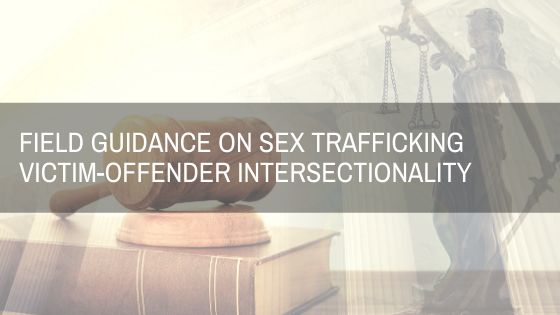
Coming Soon: Field Guidance on Sex Trafficking Victim-Offender Intersectionality

Shared Hope International, Shared Hope’s JuST Response Council and the Institute to Address Commercial Sexual Exploitation at Villanova Law are pleased to announce the upcoming release on January 23, 2020 of a field guidance report on sex trafficking victim-offender intersectionality—the phenomenon of sex trafficking survivors entering the criminal justice process for allegedly engaging in sex trafficking conduct.

This field guidance, which follows three years of collaborative research, will provide tools for criminal justice stakeholders that assist in identifying the intersection of trafficking victimization and offending conduct, as well as guidance on responding to these cases in a trauma-responsive and trafficking-informed manner. By examining some of the common factors in cases involving victim-offender intersectionality through a trafficking-informed lens, alongside specific case studies drawn from federal prosecutions, this field guidance seeks to identify strategies for moving toward more just and fair responses to sex trafficking victim-offenders at all stages of the criminal justice process.

While the field guidance specifically focuses on survivors of sex trafficking charged with sex trafficking offenses, many of the considerations that arise in that context are informative for criminal justice stakeholders responding to trafficking survivors who have been charged with other crimes as a result of their trafficking victimization. We hope this guidance will also lead to greater discourse on this difficult issue and ongoing efforts to work toward victim-centered, trauma-informed solutions.

The release of this field guidance report on January 23, 2020 also marks the Grand Opening of Shared Hope International’s new Institute for Justice & Advocacy. The work of the JuST Response Council and this new research reflect the Institute’s commitment to finding solutions to complex problems to help bring an end to juvenile sex trafficking and provide support and protection to those impacted by sex trafficking.

If you are interested in attending the event at the Institute, please register here. Space is limited. If you are not able to attend in-person, please join us remotely via Facebook Live at Shared Hope’s Facebook page.

[clear-line]

Shared Hope International’s JuST Response Council represents some of the most innovative and informed experts in the country. These members help ensure JuST Response products are informed by diverse perspectives and experiences. Council members share the goals of preventing juveniles from becoming sex trafficking victims and ensuring that youth who have been trafficked have access to the tools and support necessary to heal from the trauma they have endured and the skills to create and sustain a life away from trafficking. Members include policy advocates, government officials, medical professionals, law enforcement, judges, academics, and service providers, many of whom are themselves survivors of juvenile sex trafficking, from diverse geographic areas.

November 1, 2019 by SHI Staff

Shared Hope’s Written Testimony in Opposition to D.C. Bill 23-0318

Shared Hope International is a D.C.-based NGO focused on addressing the root causes of commercial sexual exploitation for the purpose of preventing child sex trafficking in the U.S. Since our organization’s inception in 1998, we have proactively pursued and supported policies that protect the inherent right of children in the U.S. to be free from sexual violence, including commercial sexual exploitation. Following the introduction of D.C. Bill 23-0318 in early 2019, we sought to understand the purpose and impact of this legislation, including to identify whose “safety” and “health” this piece of legislation would truly protect. Shared Hope strongly opposes the “Community Safety and Health Amendment Act” because, despite what its name purports, this bill fails to protect the safety and health of D.C. children and youth, who are an essential part of our community.

Shared Hope firmly believes that removing criminal liability for buyers, pimps, and brothel owners will significantly threaten the safety, well-being, and security of youth in the District, particularly youth living with various vulnerability factors. During the October 17th Committee hearing, Councilmembers heard hours of testimony which highlighted the forecasted impact this bill would have on the District and, most importantly, those most affected by the policies created through this effort. We adamantly affirm the numerous concerns raised by child protection and anti-trafficking advocates, including the impact this bill would have on: (1) repealing current processes for connecting exploited minors with vital services; (2) creating additional challenges for law enforcement to discern illegal activity from legal activity, thus creating barriers to victim identification and response; 3) expanding the market and increasing harm to those in commercial sex due to a rise in demand; and (4) transforming the District into a tourist destination for commercial sexual exploitation.

We can attribute the phenomenon of child sex trafficking in the U.S. to a culture that normalizes the commodification of human beings; fully decriminalizing commercial sex will uphold the already existing attitudes that tolerate the sale, purchase, and control of another person. As stakeholders, we would be shortsighted and reckless to believe that the implications of the policy this bill seeks to advance will be limited to consensual sex workers. Reinforcing a demand for human beings and their bodies will not start and end with consenting adults; the consequences of this will be horrific for vulnerable persons, including children, who do not choose commercial sex. We cannot allow the purported benefits for some to trump the well-established harm caused to others.

What remains unaddressed is what this bill painfully fails to do: create sustainable solutions to deeply rooted forms of injustice. Upon conducting a thorough analysis of the bill and watching all fourteen hours of the Committee hearing, it is evident that this piece of legislation provides a band-aid for affected communities and creates an easy fix for the Council. Over half of the witnesses testified to the systemic reasons driving the sale of commercial sex, all of which fall under the general umbrella of “survival.” Additionally, witnesses testified to the inherent violence that underpins commercial sex, detailing the dramatically high mortality rate for persons engaged in commercial sex compared to rates measuring the general public. 1 Many sex trafficking survivors and self-identified sex workers provided anecdotal accounts of the physical, psychological, and sexual violence they experienced due to commercial sex. Fully decriminalizing sex work to ensure that historically and presently marginalized communities, including vulnerable children and youth, can access shelter, employment, food, and security reinforces the unjust notion that some members of our society, disproportionately communities comprised of racial and gender-minorities, must sacrifice their safety and wellbeing to meet such fundamental needs. The Council must bypass the allure of a quick and easy fix and devote the requisite energy and resources to a problem that demands a thoughtful and sustainable solution. This is the only way of ensuring that presently impacted persons and generations to come are not positioned to choose survival over safety.

Many witnesses testified to the opportunities this bill creates; aside from importantly preventing the criminalization of affected persons, D.C. Bill 23-0318 fails to “lift up marginalized communities” as one witness purported. When the District enacted D.C. Act 20-560 in 2015, preventing minors from being charged and prosecuted for prostitution offenses, the Council responsibly included provisions to train relevant stakeholders and develop service response protocols. In fact, one of the existing protections for children, requiring law enforcement to refer an identified or suspected child sex trafficking victim to specialized services, will be repealed by this very bill that seeks to increase “safety.” Historical efforts to reform the City’s response to child sex trafficking included critical measures to ensure that exploited youth were directed away from the juvenile justice system and into services, inarguably supporting their holistic health and safety, and providing access to justice and opportunities. Conversely, this bill merely develops a task force to “study . . . the need for . . . resources to meet the needs of sex workers and other individuals engaging in commercial sex.” As detailed during the Committee hearing, the extensive needs are already well-established; in fact, the lack of these very services that the Committee seeks to study is what survivors of sex trafficking and consensual sex workers claim is driving their engagement in commercial sex. Rather than passing legislation that preys on vulnerabilities, the Council should invest in eliminating them by: (1) removing criminal liability for persons who sell sex, either consensually or through exploitative practices; and (2) creating access to comprehensive care and services, as well as meaningful opportunities for those desiring to cease engagement in commercial sex.

D.C. Bill 23-0318 blatantly ignores the cries of sex trafficking survivors and ally professionals that, based on a culmination of lived experience and sound research, denounce both the intent and resolution. Several proponents voiced frustration at the Council’s willingness to hear from opponents outside of the District; their voices speak to the enormous ramifications this bill will have on sex trafficking victims and vulnerable communities across the U.S. Vacuums of equitable opportunity are a magnet for exploitation. Undoubtedly, a general lack of opportunity and services, coupled with legislation that decriminalizes the purchase and pimping of human beings, will set the stage for an increase in child sex trafficking in D.C.

We respectfully urge the Council to listen to the collective concern of stakeholders who demand better for all vulnerable persons and communities. The District does not need a new task force to establish and respond to the imminent needs that drive exploitation and survival sex; rather, the Council is currently positioned to draw upon the fourteen hours of testimony and re-design legislation that empowers, protects, and invests in our community.

October 10, 2019 by SHI Staff

Oppose the DC Decriminalization Bill

Shared Hope stands with survivors of sex trafficking and opposes D.C. Bill 23-0318, Community Safety and Health Amendment Act of 2019. Supported by the lived experiences of survivors and our 20+ years of work in the field, it is indisputable that legislation to decriminalize the purchase and sale of another for sex will both perpetuate and normalize harm against already vulnerable communities and populations, especially youth. In fact, the only reliable way to protect survivors who have been positioned through force, fraud, coercion or circumstance to engage in commercial sex is to eliminate criminal liability specifically for them and instead, provide access to specialized services. Indeed, this move will prevent future exploitation and radically shift a culture that standardizes the commodification of human beings.

Our position on this bill echoes our policy priorities over the last 10 years. Since 2010, we have been advocating for meaningful protections for survivors of child sex trafficking, including non-criminalization laws and the development of comprehensive care and services. We have seen enormous progress in this area of law; resultantly, we have witnessed a radical shift in how survivors and perpetrators are regarded. In fact, 29 states and D.C. have passed critical legislation to correct the historic injustice of holding minors accountable for their own victimization and providing a pass to offenders. Efforts like D.C. Bill 23-0318 will not only undermine this progress but will revert the District to a place that is unsafe for vulnerable populations and friendly to those who wish to exploit them.

Contrary to its name, D.C. Bill 23-0318 will not increase the safety and health of individuals who have experienced or are at risk of experiencing commercial sexual exploitation. The bill, and the supporters of it, seem to ignore the hundreds of sex trafficking survivors who are unwavering in their fear and belief that D.C. Bill 23-0318 will drastically reduce the safety and well-being of current trafficking victims and persons at risk of exploitation. Despite a demand for the provision of holistic services and meaningful criminal justice reform to benefit trafficking survivors and self-identified sex workers alike, this bill provides neither.

As we call on the D.C. Councilmembers to prioritize the true safety and well-being of our communities and oppose the Community Safety and Health Amendment Act of 2019, we have also compiled some ways that you can share your voice in opposing this legislation.

Action for DC residents:
Sign up to testify in person. Email the Judiciary Committee at judiciary@dccouncil.us.  Provide your name, telephone number, organizational affiliation, and title (if any) by close of business on Monday, October 14.
Tweet and/or email the D.C. Councilmembers through our “Oppose D.C. Decrim” campaign.
Tweet using the hashtags #Stop318DC, #ProtectSurvivorsNOTBuyers, #FullDecrimHurtsEveryone

Action for everyone:
Tweet and/or email the D.C. Councilmembers through our “Oppose D.C. Decrim” campaign.
Tweet using the hashtags #Stop318DC, #ProtectSurvivorsNOTBuyers, #FullDecrimHurtsEveryone
And as everyone at Shared Hope is packing our bags to head to Cincinnati for the JuST Conference, we are thankful for our allies who will be on the ground at the hearing. To stay up to date on the efforts to oppose this legislation, follow these key allies on social media for regular updates on the DC decrim effort: @rights4girls, @Courtneyshouse, @NCOSE, @DCChildrensLaw, @WorldWEUS

October 4, 2019 by Guest

How to Stay Engaged with #JuST2019 on Social Media

By Gunnar Simonsen

As we begin the final countdown to this year’s JuST Conference in Cincinnati, Ohio on October 15-17, we want to share with you strategic ways you can get the most out of it, whether you are attending or not.

What Is The JuST Conference? 

The JuST Conference is an unforgettable and inspiring conference that features today’s most pressing issues in the anti-sex trafficking field. Presentations and workshops focus on skill-building, survivor experiences, cross-discipline collaboration, task force development, case studies and lessons learned. The JuST Conference continues to stand by the motto that each person has a role to play in preventing and ending commercial sexual exploitation and that a collaborative community response is critical. Whether you are just getting started or have been working on the issue for years, the JuST Conference will have something for everyone.

How Can Attendees Maximize Their JuST Conference Experience?

If you are attending this year’s conference, here are some ways that you can maximize your experience by taking it online and getting social with it. 

  • Do you use social media? If so, please be sure to be following Shared Hope International on Facebook, Instagram, Twitter! 
    • Facebook – facebook.com/sharedhopeinternational
    • Twitter – twitter.com/sharedhope
    • Instagram – @sharedhopeinternational
  • When posting from the JuST Conference, be sure to use the official hashtag, when applicable: #JuST2019
  • If you were a reporter, what would you share on social media from the conference? Pictures, quotes, questions, ideas, solutions, and so much more! But whatever you post, just be yourself. Your unique perspective is so valuable to us all.
  • Tag presenters on Twitter! When appropriate, tag them and share what you took away from their presentation. This is a great way to continue the discussion long after the presentation is over.
  • Remember, if social isn’t in social media, it’s just media. And that’s the difference between a monologue and a dialogue. Be sure to engage others who are posting using the hashtag as well as replying to comments made by others on posts. A rising tide lifts all boats, so let’s grow together in our knowledge and in doing so, help spread awareness across social media.

How Can Non-Attendees Glean From The JuST Conference? 

The power of social media and the accessibility it offers can take people from all over the world and place them right at the conference itself. Two places you can expect to see a lot of activity from this year’s conference on Twitter and Instagram Stories. With Instagram stories, we’ll seek to provide a viewpoint from behind the scenes of what’s happening at the conference. From inside looks at workshops and plenaries to attendee testimonies, this will be a great way to see the JuST Conference without physically being in Cincinnati with us. 

On Twitter, you can both follow and engage our conference hashtag, #JuST2019 by retweeting, commenting, and taking part in the dialogue with a community of Twitter users utilizing that hashtag from the event. 

Of course, be sure to be following Shared Hope on Facebook and watch for our daily updates that you can like, comment, and share with your network, too. And don’t be afraid to reply to comments made by others. In this, we all might just expand our reach, by increasing our network. 

The more we comment and share the more people we will reach with a message that needs to be heard. 

Follow Shared Hope On Social Media

Facebook – facebook.com/sharedhopeinternational

Twitter – twitter.com/sharedhope

Instagram – @sharedhopeinternational

Sign up to receive updates about Shared Hope and the 2020 JuST Conference

[clear-line]

*Please refrain from photography or videography of presenters, attendees or PowerPoint materials unless authorization is granted by Shared Hope staff and/or the workshop presenter This conference has many individuals in attendance that do not wish to have their identities or materials shared on public platforms If you would like to take photos with your peers for social media, please do so with a neutral background and be sure to gain permission to post the photo from all parties involved Be sure to check out our Instagram story and Facebook posts! Search for Shared Hope International Thank you for respecting the privacy of our attendees and presenters

  • < Previous Page
  • 1
  • …
  • 25
  • 26
  • 27
  • 28
  • 29
  • …
  • 121
  • Next Page >
  • What We Do
  • Newsletter Signup
  • Take Action
  • Donate
Shared Hope International
Charity Navigator Four-Star Rating

STORE | WEBINARS | REPORTCARDS | JuST CONFERENCE
 
Donate

1-866-437-5433
Facebook X Instagram YouTube Linkedin

Models Used to Protect Identities.

Copyright © 2026 Shared Hope International      |     P.O. Box 1907 Vancouver, WA 98668-1907     |     1-866-437-5433     |     Privacy Policy   |   Terms of Service

Manage your privacy
SHARED HOPE INTERNATIONAL DOES NOT SELL YOUR DATA. To provide the best experiences, we use technologies like cookies to store and/or access device information. Consenting to these technologies will allow us to process data such as browsing behavior or unique IDs on this site. Not consenting or withdrawing consent, may adversely affect certain features and functions.
Functional Always active
The technical storage or access is strictly necessary for the legitimate purpose of enabling the use of a specific service explicitly requested by the subscriber or user, or for the sole purpose of carrying out the transmission of a communication over an electronic communications network.
Preferences
The technical storage or access is necessary for the legitimate purpose of storing preferences that are not requested by the subscriber or user.
Statistics
The technical storage or access that is used exclusively for statistical purposes. The technical storage or access that is used exclusively for anonymous statistical purposes. Without a subpoena, voluntary compliance on the part of your Internet Service Provider, or additional records from a third party, information stored or retrieved for this purpose alone cannot usually be used to identify you.
Marketing
The technical storage or access is required to create user profiles to send advertising, or to track the user on a website or across several websites for similar marketing purposes.
  • Manage options
  • Manage services
  • Manage {vendor_count} vendors
  • Read more about these purposes
Manage options
  • {title}
  • {title}
  • {title}
Shared Hope InternationalLogo Header Menu
  • The Problem
    • What is Sex Trafficking?
    • FAQs
    • Glossary of Terms
  • What We Do
    • Prevent
      • Training
      • Awareness
    • Restore
      • Programs
      • 3rd Party Service Providers
      • Stories of Hope
      • Partners
    • Bring Justice:Institute for Justice & Advocacy
      • Research
      • Report Cards
      • Training
      • Advocacy
  • Resources
    • All Resources
    • Internet Safety
    • Policy Research and Resources
    • Store
  • Take Action
    • Activism
    • Advocate
    • Just Like Me
    • Volunteer
    • Give
  • News&Events
    • Blog & Events
    • Media Center
    • Request a Speaker
    • Host an Event
    • Attend an Event
  • About
    • Our Mission and Values
    • Our Story
    • Financial Accountability
    • 2024 Annual Report
    • Leadership
    • Join Our Team
    • Contact Us
  • Conference
  • Donate