Shared Hope International

Leading a worldwide effort to eradicate sexual slavery...one life at a time

  • The Problem
    • What is Sex Trafficking?
    • FAQs
    • Glossary of Terms
  • What We Do
    • Prevent
      • Training
      • Awareness
    • Restore
      • Programs
      • 3rd Party Service Providers
      • Stories of Hope
      • Partners
    • Bring Justice:Institute for Justice & Advocacy
      • Research
      • Report Cards
      • Training
      • Advocacy
  • Resources
    • All Resources
    • Internet Safety
    • Policy Research and Resources
    • Store
  • Take Action
    • Activism
    • Advocate
    • Just Like Me
    • Volunteer
    • Give
  • News&Events
    • Blog & Events
    • Media Center
    • Request a Speaker
    • Host an Event
    • Attend an Event
  • About
    • Our Mission and Values
    • Our Story
    • Financial Accountability
    • 2024 Annual Report
    • Leadership
    • Join Our Team
    • Contact Us
  • Conference
  • Donate
Home>Archives for Guest

August 15, 2014 by Guest

5 Reasons Why Demand Enforcement Matters

Purchasing sex is now a well-accepted pastime in the United States. It’s not uncommon for men to visit strip clubs for a bachelor party or speak openly about consumption of pornography. Commercially depicted sexualization is so normal that in one study investigating the effects on men who view pornography, social scientists were unable to find a negative control group, meaning that the researchers were unable to find men who never consumed pornography to interview as a baseline for research results (Lajeunesse – 2009). Demand for commercial sex is now an unquestioned component of American culture and interference with an individual’s sexual preferences in this area is viewed as a violation of autonomy.

These societal norms do not exist in a vacuum and without consequences; they extend into law enforcement and judicial perspectives as well. In a culture where everything can be bought and sold, why does demand enforcement matter?

1. Buyers must be exposed.

Men are able to purchase sex with children because no one is watching them or holding them accountable. Right now, buyers have little to fear. The game changes when law enforcement and prosecutors apply strong laws with substantial penalties against buyers. A $10,000 fine for soliciting a minor for prostitution means the married buyer has to explain to his wife why their savings account is depleted. Asset seizure of the buyer’s vehicle will result in questions from the buyer’s employer when the buyer struggles to arrive to work on time the next week. The buyer’s registration on the sex offender registry means he has to explain to his family why they can’t live within 1000 feet of a school zone. When buyers are incapable of hiding their crimes, enforcement rises to a deterrent level and men stop buying out of fear of being caught.

2. If no one is buying, then traffickers won’t sell children for sex.

Human trafficking is an economic crime and is the destructive, profit-maximizing form of prostitution. Psychological factors influencing motives of traffickers are varied, but money is at the top. When a trafficker sells a child for sex, the trafficker receives all the proceeds from the exchange. The buyer’s participation in a human trafficking offense supplies the trafficker with money and encourages the trafficker to maintain control over victims through manipulation, force, and violence in order to keep selling that child victim. Enforcing laws against buying sex with minors dismantles trafficking enterprises by eroding the trafficker’s financial gain.

3. Stop the victim blaming.

Imagine that you’re a 16 year old girl from a broken home in a poor neighborhood and you meet a man who claims to love you, promises you freedom, and lavishes you with gifts. Before you know it, he flips the switch. He may be abusive and force you to walk the street or advertise on the internet for sex acts with strangers. Or he may manipulate you into believing he needs you to sell sex acts in order to support him so he can continue to love you. After months of this, you’re alone in a hotel room with yet another man who is renting you for a half hour from your trafficker and you’re interrupted by the forceful knock of the local VICE unit on your hotel room door. Your nightmare is over, right?

Wrong. The buyer claims he didn’t know you are 16 and is sent home to his wife and kids instead of jail. But you’re charged with prostitution, facing punishment. When laws against buying sex with minors are enforced, law enforcement see the true criminals and the child victims are steered away from punishment and toward healing.

4. Buying sex with children is a crime of human trafficking.

Demand enforcement makes sense from an economic and criminal justice perspective. Traffickers know that a thriving market exists for sex with children so they operate as procurers of the supply – child victims. Unlike commercial goods which have a 1:1 ratio of sale to consumption, trafficking victims can be sold repeatedly to thousands of buyers. The buyers, or the demand, are the driving force behind sex trafficking and should be punished accordingly. Enforcement of demand laws like those which criminalize purchasing sex with a child directly supports the underlying policy goal of identifying buyers as the fuel behind the sex trade.

5. When there’s no demand, sex trafficking vanishes.

Men who buy sex with children spend their money in conventional ways just like everyone else. Their purchasing decisions include things like rent, gasoline, and groceries. However, these goods are different from commercial sex in that they are inelastic– the person will continue to buy these goods or make payments on them even if the price of the good increases significantly. In other words, the person’s buying habits remain the same even though these goods are now much more expensive.

However, a buyer’s purchasing habits will change or stop altogether when the price of an elastic commodity becomes too expensive. The question becomes, how do we make it so expensive for the buyer to purchase sex with a child that the cost makes an impact on his purchasing decision? Enforcing strong demand laws and aggressively prosecuting buyer offenses will produce a chilling effect on the market for commercial sex. Basic economics teaches us that when demand (buyers) for a commodity decreases, the supply (victims) also decreases. When demand drops to zero, sex trafficking vanishes.
June 24, 2014 by Guest

SAVE Act Targets the Advertisement of Human Trafficking Victims

By: Eion Oosterbaan

As its use becomes increasingly universal, the Internet has drastically changed the face of human sex trafficking.  Through this medium, criminals have found a way to expand their reach of influence while simultaneously reducing the risk of their detection by law enforcement to a significant extent.  Traffickers, or pimps, have taken their business operations from the streets to the online realm, openly advertising their victims as if they are items for sale on websites like Backpage.com and Craigslist.  This new practice has caused the selling of human beings for sex to become enormously profitable as human sex trafficking now generates $9.5 billion yearly in the United States.  With hundreds of potential buyers from all over the country viewing these ads daily, a trafficker can make anywhere from $150,000 – $200,000 per child victim in a given year.

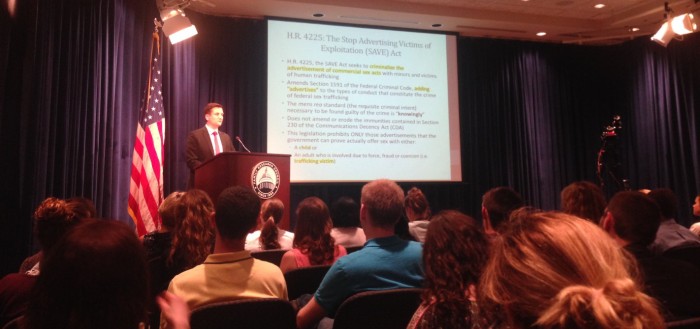
SAVE-act2Even more surprising is the fact that websites earned a total of $45 million in revenue from prostitution advertising in the United States last year.  In the average month Backpage.com receives $4-$5 million from these types of ads, which often involve underage children.  Legitimate, legal, multimillion dollar corporations are currently profiting from criminal activity and the plight of trafficked children as they generally choose to ignore the fact that their services are facilitating these crimes.  It should be noted that not every corporation has disregarded this issue, however, as Google has recently made a highly publicized decision to remove all pornographic ads and links to sexually explicit websites from their services.

In order to limit the prevalence and profitability of human sex trafficking and to hold services like Backpage.com accountable, Congresswoman Ann Wagner and members of the Republican Task force on Human Trafficking in the 113th Congress have worked to create the Stop Advertising Victims of Exploitation Act (SAVE Act).  The SAVE Act seeks to criminalize the advertisement of commercial sex acts with minors and victims of human trafficking by amending Section 1591 of the Federal Criminal Code to include “advertising” to the types of conduct that constitute the crime of federal sex trafficking.  This act would effectively target the traffickers posting the ads in addition to the website organizations where the ads are posted.  The bill has already passed through the House of Representatives with overwhelmingly bipartisan support, and has just recently been introduced in the Senate.

The SAVE Act directly coincides with Shared Hope International’s current activity in its fight to eradicate human trafficking.  Shared Hope has taken a proactive approach to the issue of these illicit advertisements by using its resources to identify, track, and report instances of human trafficking activity on websites like Backpage.com.  The criminalization of human trafficking advertisements would significantly increase the impact of this work.  In addition, Shared Hope International’s Sex Trafficking Identification and Response Training would provide the necessary capacity to deal with these types of advertisements.

*Facts and statistics retrieved from the Family Research Council presentation on the SAVE Act at:

http://www.frc.org/eventregistration/pornography-and-sex-trafficking-stopping-online-advertisers-of-trafficking-victims-with-the-save-act

June 13, 2014 by Guest

My 6-Year-Old Daughter Introduced Me to Sex Trafficking

giftBy: Gunnar Simonsen

When my daughter was little she received $30 for her birthday that she could spend on whatever she wanted. Of course, we thought she would want to spend it on a stuffed animal or toy.

But we were wrong. Very wrong.

When her mom asked her what she wanted to spend it on, she asked for the catalog we received from a non-profit humanitarian organization. It was the kind where you could purchase things like goats, chickens, food, and clothing for people in need throughout the world.

We figured she would want to buy some chickens for a family or clothing for a child, tangible items she was familiar with. But as she looked through the catalog, she kept turning the pages until she found what she was looking for.

What she did next, we’ll never forget.

She found the page she was looking for. She decided to spend her $30 to help girls and boys who had been rescued from sex trafficking.

She was 6 years old.

When asked why she chose to spend her money that way, she responded with “as an only child, these are the brothers and sisters I never had. I need to take care of them.”

In that moment I learned that too often the difference between adults and children was simply that children still believe they can change the world.

She went on to raise several thousand dollars to help more children.

Through the eyes of my 6-year-old daughter, this was my introduction to sex trafficking. I would also learn soon after that sex trafficking wasn’t just something that only happened in other countries, it was also happening in my own backyard.

I met up with a friend of mine shortly after my daughter donated her birthday money to aid victims of trafficking. He was blown away by her heart to help others. He then paused, looked me straight in the eye, and said four words…

Don’t let her down.”

It was like a thousand arrows had simultaneously hit their mark. Those four words still pierce my heart to this day.

It has been ten years since my daughter introduced me to sex trafficking. Ten years since she introduced me to brothers and sisters I, too, never had. Ten years since she opened my eyes to this scourge on humanity.

For me, “don’t let her down” meant that with sex trafficking happening in my own backyard, there was work to do.

Since then, I found myself actively engaged in the fight to eradicate sex trafficking. From the incredible inspiration of many new friends (the brothers and sisters I never had) who have survived being sex trafficked to organizations like Shared Hope International and their work to prevent, restore, and bring justice in this fight, my heart’s cry is that maybe, just maybe, my actions have begun to live up to the impact of those first $30.

For certain, there is much work left to be done and sadly too many who need yet to be freed. And so, because a 6 year old paid it forward with everything she had, how could I not go forth and do the same?

On this Father’s Day, I will look back with thankfulness on these past ten years since my eyes were opened. Certainly what I saw was anything but something to be thankful for. However, because of my daughter, I not only saw the effects of sex trafficking, I was now responsible to do my part in ending the cause of sex trafficking, too. In this, I simply could not let her, and the many brothers and sisters that she and I never had, down.

So it is because of her actions that on this Father’s Day, I truly do reflect back on the past ten years with thankfulness. Thankfulness to a daughter that helped me return to that belief I once had as a child, in that perhaps I too can help change the world.

What about you?

May 28, 2014 by Guest

Prevention, Protection, and International Cooperation Against the Use of Technologies to Exploit Children

23rd Session of the Commission on Crime Prevention and Criminal Justice Conference

By: Eion Oosterbaan

In May 2014, a panel discussion meeting took place at the United Nations Office of Drugs and Crime (UNODC) at its headquarters in Vienna, Austria.  This discussion served as a side event to the Twenty-third session of the Commission on Crime Prevention and Criminal Justice Conference, specifically focused on the prevention, protection, and international cooperation against the use of new information technologies to abuse and/or exploit children. Eion Oosterbaan attended as a representative of Shared Hope International.

UNIn attendance to speak as members of the discussion panel were Tejal Jesrani of the UNODC, Bjorn-Erik Ludvigsen of NCIS Norway, Andrew Oosterbaan of the USDOJ Child Exploitation and Obscenity Section, and Ethel Quayle of the University of Edinburgh.


The discussion opened up with an outline of the UNODC’s Study and Technical Assistance Programme to Combat the Misuse of Internet Communications Technology (ICTs) to Abuse and Exploit Children.   The study pointed out the severe and increasing threat that developing technologies pose to our children, and how the use of technology has enhanced the ability of sexual predators to commit offenses.  The use of ICTs has allowed predators to enhance their access to child victims, increase levels of harm and re-victimization, and it has increased the profitability of criminal enterprises.  The severe difficulties of keeping pace with the criminal usage of this quickly evolving technology has presented law enforcement many issues with combating these criminals.

Currently,  law enforcement is falling behind as they severely lack the proper resources to contain the criminal activity of these predators online.  The scale of child abuse on the Internet is too large and widespread to completely eradicate.  New developments in technology have allowed individuals to hide their identity (through the use of IP Address encryption and web browsers such as Tor) as they increase the frequency and ease of their online sexual offenses.  It has become incredibly difficult to track and identify these skilled offenders, as they have found a haven through technology.

The experts on the panel stressed the importance of keeping up with the technology that sex offenders are now using.  If mastered, the use of ICTs can actually be used as a tool for prevention and detection.  Law enforcement has undertaken a policy of proactive investigation through the use of computer forensics to detect and identify online offenders, and they have recognized the need to increase the perceived sense of police presence on the Internet (“Fear of Detection”) as a key to crime prevention. The panelists also stressed the importance of increased information sharing as a key method to combating online child abuse.  Internationally, we must be more willing to share/exchange information and we must establish a certain level of cooperation between Internet Service Providers (ISPs) and law enforcement.

Overall, this meeting/discussion served as a means to identify the significant threat that developing technologies pose to children, get the issues out there, and begin the process of creating a viable solution.  The experts on the panel admitted that there currently exists no concrete solution, but stressed the importance of continuing the conversation and making this a subject of high priority.

Shared Hope International has joined in the effort to help prevent and combat the threat of sexual predators online, and recognizes the dangers that the misuse of technology presents.  The use of ICTs has greatly enhanced the ability for buyers to find and make contact with victims of human trafficking.  Girls are openly advertised on Internet websites like Backpage and Craigslist, yet the identities of the girls, their pimps, and their buyers remain protected and undetectable.  Shared Hope has taken this issue head on, using its expertise and resources to provide Sex Trafficking Identification and Response Training while also tracking the human trafficking cases found on these ICTs.

May 27, 2014 by Guest

LifeSiteNews – Bill would Punish Countries that Legalize Prostitution for Driving Human Trafficking and Sex Slavery

According to Vardaman, who is the senior director for anti-trafficking organization Shared Hope International, H.R. 4703 “is a clear and specific mandate to the State Department” to target the demand for human trafficking. She told LifeSiteNews that Hultgren’s legislation would add teeth to the TIP report, which she said has been used effectively “with regard to demand.”

“We know that demand is why sex trafficking exists,” Vardaman explained. “If people weren’t buying commercial sex acts or demanding forced labor, there would be no trafficking.”

Vardaman says that Hultgren’s bill highlights that “if a country can prohibit purchase of commercial sex acts and fails to, then they should be considered to be failing to deter demand.” According to Vardaman, this means the nation is “failing to make serious efforts to eliminate trafficking.”

“The two are inextricably linked,” she says. “HR 4703 is a thoughtful, surgical approach to reinforcing the U.S. leadership on eliminating human trafficking globally.”

FULL STORY – LifeSiteNews – Bill would Punish Countries that Legalize Prostitution for Driving Human Trafficking and Sex Slavery

More Media & News Coverage 2014

  • < Previous Page
  • 1
  • …
  • 23
  • 24
  • 25
  • 26
  • 27
  • …
  • 37
  • Next Page >
  • What We Do
  • Newsletter Signup
  • Take Action
  • Donate
Shared Hope International
Charity Navigator Four-Star Rating

STORE | WEBINARS | REPORTCARDS | JuST CONFERENCE
 
Donate

1-866-437-5433
Facebook X Instagram YouTube Linkedin

Models Used to Protect Identities.

Copyright © 2026 Shared Hope International      |     P.O. Box 1907 Vancouver, WA 98668-1907     |     1-866-437-5433     |     Privacy Policy   |   Terms of Service

Manage your privacy
SHARED HOPE INTERNATIONAL DOES NOT SELL YOUR DATA. To provide the best experiences, we use technologies like cookies to store and/or access device information. Consenting to these technologies will allow us to process data such as browsing behavior or unique IDs on this site. Not consenting or withdrawing consent, may adversely affect certain features and functions.
Functional Always active
The technical storage or access is strictly necessary for the legitimate purpose of enabling the use of a specific service explicitly requested by the subscriber or user, or for the sole purpose of carrying out the transmission of a communication over an electronic communications network.
Preferences
The technical storage or access is necessary for the legitimate purpose of storing preferences that are not requested by the subscriber or user.
Statistics
The technical storage or access that is used exclusively for statistical purposes. The technical storage or access that is used exclusively for anonymous statistical purposes. Without a subpoena, voluntary compliance on the part of your Internet Service Provider, or additional records from a third party, information stored or retrieved for this purpose alone cannot usually be used to identify you.
Marketing
The technical storage or access is required to create user profiles to send advertising, or to track the user on a website or across several websites for similar marketing purposes.
  • Manage options
  • Manage services
  • Manage {vendor_count} vendors
  • Read more about these purposes
Manage options
  • {title}
  • {title}
  • {title}
Shared Hope InternationalLogo Header Menu
  • The Problem
    • What is Sex Trafficking?
    • FAQs
    • Glossary of Terms
  • What We Do
    • Prevent
      • Training
      • Awareness
    • Restore
      • Programs
      • 3rd Party Service Providers
      • Stories of Hope
      • Partners
    • Bring Justice:Institute for Justice & Advocacy
      • Research
      • Report Cards
      • Training
      • Advocacy
  • Resources
    • All Resources
    • Internet Safety
    • Policy Research and Resources
    • Store
  • Take Action
    • Activism
    • Advocate
    • Just Like Me
    • Volunteer
    • Give
  • News&Events
    • Blog & Events
    • Media Center
    • Request a Speaker
    • Host an Event
    • Attend an Event
  • About
    • Our Mission and Values
    • Our Story
    • Financial Accountability
    • 2024 Annual Report
    • Leadership
    • Join Our Team
    • Contact Us
  • Conference
  • Donate